“Season of mists and mellow fruitfulness,
          Close bosom-friend of the maturing sun—"
Those are the opening lines of the ode “To Autumn” by John Keats, and when those mists again come rolling out of the woods behind our house, my wife Michele and I read the poem together as a seasonal ritual. Keats was dying when he wrote that poem—and he knew he was dying. Instead of collapsing into a ball of grief and fear and waiting to die, he roused himself to get up and write that brilliantly woven and lush-sounding poem, one of his most memorable. And if you wonder about, and possibly admire, the motivation that could drive a human being to do something so foolish and miraculous as that, you are in the right place tonight. And so…
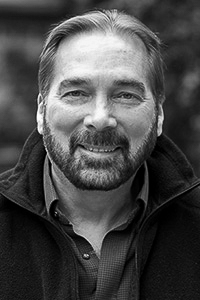
Good evening! My name is Gregory Donovan—I have taught in the creative writing program here at VCU since I came to Richmond in 1983 as one of the program’s faculty founders, and I was the Director of the Levis Reading Prize from the time it presented its first award in 1998 until this year, when I retired and passed the torch to our two new faculty members, both highly accomplished poets and multi-genre writers that we are so very fortunate to have brought here: Edgar Kunz and Devon Walker-Figueroa—and Devon actually won the prize herself back in 2022.
As the award’s co-directors, Devon and Edgar invited me to come back again for this very special occasion marking the publication of Swirl & Vortex, the astonishing volume of the collected poems by Larry Levis edited by his good friend David St. John, with the able assistance of Associate Editors L.A. Johnson and James Ciano—all of whom have joined us here this evening. It is my pleasure to give this welcoming address to all of you as I have done for years now, inviting the spirit of Larry Levis to this memorial occasion meant to honor him, as well as to honor the 29th winner of the annual prize named after Levis, won this year by Matthew Tuckner, author of the remarkable poetry collection titled The Decline and Fall of the Roman Empire. I warmly welcome you who are here in person and all of you out there in virtual-land to this unique celebration of the 2026 Levis Reading Prize, which is presented annually by the MFA in Creative Writing Program in the VCU Department of English and by VCU Libraries and Dean Warren, with additional support from the VCU College of Humanities and Sciences and Dean Catherine Ingrassia. (I like deans who come to poetry readings!)
For their helpful assistance this evening, I also want to thank Ryan Larson and the VCU Libraries event staff, who not only arranged for hosting this event here in the library but also for broadcasting it to our audience online. And now, for the sake of the people around you here, as well as for the recording of this event, please kindly mute your cell phones and then put them away, if you haven’t already done so.
The judging of this prize is a year-long process to select the most outstanding first or second poetry collection published in English in the previous calendar year. First, graduate students in our MFA in Creative Writing program read the submitted books and choose a group of finalists who go into the next round, where a final decision is made by the MFA program’s creative writing faculty in poetry. In that way, this is a community process, and a big thank you to the graduate students who participated, and a special thanks is owed to last year’s Levis Prize Coordinator, Matthew Schroeder, who collected the books and supervised the judging of well over a hundred entries, and many thanks as well to this year’s Levis Prize Coordinator, Bhavya Bhagtani, another outstanding and talented student in our MFA program, who has not only undertaken that same task but also, with the alert assistance of Thom Didato in our department, has helped to provide some of the background logistics work required to publicize and to organize this event. Thank you all.
Matthew Tuckner’s books are available for purchase here this evening, and after the reading, he will be available to sign your copy for you and chat a bit.
My wonderful colleague Kathleen Graber not only printed the beautiful hand-sewn programs for this three-day Levis festival, but she has also once again created handmade letterpress poetry broadsides to commemorate this evening’s event with Matthew Tuckner, and they are available to you free of charge if you would like one. I love that she does that—working with her own letterpress.
Having mentioned Swirl & Vortex, I might tell you a little story about a surprising development that allowed me to offer some unusual assistance to the editing of this invaluable book. On the day after Larry Levis died, all of us in the MFA program and in the English Department and his friends all over the city were in a kind of daze, a combination of disbelief, shock, and grief over the loss of such a lively person, and there was a danger I perceived in the university’s desire to enter Larry’s office and take away his computer and other papers. I insisted that the office remain closed and locked—I had the outer office that was part of our two-room suite and a key to the outer door—and immediately I went in to turn on his computer and, using the now-antique technology of the Zip disk (which replaced floppy disks), I made copies of everything that was on Larry’s computer, which I intended to keep safe until a more organized and official plan could be used to handle his work and papers.
Soon Larry’s sister, Sheila Brady, who is in the audience tonight, came along as his literary executor, and she began to work with Philip Levine as well as David St. John, who together edited Elegy, and St. John would go on to edit all of the additional posthumous collections, now including Swirl & Vortex. Sheila Brady, Mary Flinn, and I were also involved in establishing this Levis Reading Prize with the intention of keeping Larry’s amazing writing in the public eye. Ultimately, his papers and digital records were purchased by the VCU Libraries and are safely preserved here for scholars and readers on into the future. Sheila and Mary were also directly involved in helping the VCU Libraries acquire the Levis papers–and since they are in the audience tonight, we should give Sheila and Mary a hand, thanking them for all that they’ve done to give attention to, and preserve, the writing of Larry Levis.
Meanwhile, I quietly kept my digital copies of Larry’s work as a kind of failsafe backup in case anything unexpectedly went haywire, and I told no one about that, as a further safety measure.
However, also meanwhile, the posthumous editing of Larry’s poems saved on his computer was made much more difficult by the fact that, ever the rebellious scofflaw, Larry had never dated a single one of his files, which was not automatic in those days, so it was a complexity of guesswork to decide which version of a poem might be the final one. That was made an even bigger problem because Larry was in the habit of migrating whole blocks of text, many lines at a time, from one poem to another and another, seeking their ideal placement. And sometimes, like all of us, he may have revised poems even after their publication in a journal. The editing was a huge yet vital challenge.
Then one day many years later, out of idle curiosity, I fired up the old Zip disk drive to see if the files I’d kept safe were still readable, and I discovered that because of a new operating system, the “save” dates of the files now magically appeared in the listed contents. Later, David St. John joined me here at the VCU Library, and with the superb assistance of Ken Hopson, the Manager of the Creative Technologies and Scholarship department here, we made an updated copy of all those materials, with the dates of each file shown. David St. John has said to me that the ability to make use of those dates provided essential guidance for many significant editorial decisions that now, among other factors, including discoveries of previously uncollected poems, give added value to Swirl & Vortex, whose publication is a major watershed moment for the large and diverse community of readers nationwide and around the world who are inspired by the poetry of Levis, as illustrated by the wonderful group of Levis fan-poets who read and offered their appreciation of his poems yesterday evening.
And now here’s my traditional brief essay for this evening, titled—
The Urgent Drive to Make a Poem
There are some parallels to be drawn between the end-of-life stories of John Keats and of Larry Levis, both of them driven to make poems, no matter what. In the early days of the Levis Reading Prize and its events, as its Director, I was called upon to give some remarks about Levis and his work. The audience at that time largely included friends and students of Larry’s. I saw my job then was to give those people, many of them still grieving his death, some details about his life they might not have known, anecdotes that would be enlightening and possibly bring on a smile—and that was how I brought his presence to this event, which was then, as it is now, a memorial as well as a celebration. For example, back then I might have mentioned that Amy Tudor, one of Larry’s students with whom he had an especially close, fatherly sort of relationship—and I should also mention that Amy Tudor is now back at VCU and teaching wonderful courses here—well, Amy had named one of her cats Larry Levis. And the human Larry Levis very much enjoyed listening to the latest exploits of his alter ego Larry Levis, who had a number of bad habits, knocking over the kitchen trash can, scratching up the furniture, escaping to go out on dubious romantic adventures, and much more merry devilment. The human Larry always checked in with Amy to find out the latest news about the naughty Larry Levis—the human Larry Levis seemed to identify with the other’s daring, implacable, sneaky, fearless, and unapologetic ways. And at that first Levis Reading Prize event in 1998, I finished my talk by offering the heavily ironic poem that was Larry’s most requested poem at his readings, “The Poem You Asked For.” The title itself is a kind of sardonic dare, as if to say, well, you asked for it. The poem usually gets a laugh—at first.
However, as time went on, the audience for this event grew larger and larger, including audiences tuning in via Zoom, and more and more it was made up of people who hadn’t known Larry at all, never met him, and many of them didn’t yet know that much about his writing, either. So I began to focus on a single poem each time, sketching its background and giving a lively preparation for a reading of each poem I presented, not unlike the ones we enjoyed last evening. I hoped to give the audience an intriguing invitation which might allow everyone an entryway into his work, into their brilliant inventions and vivid imagery, their powerful stories and magical, mind-blowing phrasings, and that abundant spiritual and emotional quality which Kathy Graber in the Levis documentary perceptively says is a kind of tenderness, and which I might simply call heart. Strong, tough, sharp, intelligent, scintillating poems that are, nevertheless, not sentimental, but subtly full of heart. If you attend the showing of the documentary film about Levis that will be screened tomorrow at 3:00 on the big screen of the Commons Theater—which is the best way to experience the film—you will find out much more about Larry’s singular devotion to his writing, which in his life seemed to come before everything else, and no matter what disaster or triumph was going on in his life, he made time for writing. And each one of the many remarkable and often famous poets who were interviewed in the film was asked not only “Is poetry necessary?” but also “Is self-destruction required for a life fully committed to art?” Larry Levis actually died in the midst of writing, dangerously using drugs to make his marathon day-and-night writing sessions possible, a strategy that worked for a long time—until it didn’t.
So, in this moment of looking back over a life’s worth of writing collected in Swirl & Vortex, it seems right to return to that first time I gave this talk almost thirty years ago, and to the poem that he was so often asked to read, and it is him reading that poem that provides the ending to the documentary film A Late Style of Fire. It is a poem that works hard to joke about the risks and sacrifices required for a serious commitment to make a truly memorable, fully alive poem, but in the end, it also illustrates the harsh truth about what that effort might take, which is, in the end, nothing less than everything.
The Poem You Asked For
My poem would eat nothing.
I tried giving it water
but it said no,
worrying me.
Day after day,
I held it up to the light,
turning it over,
but it only pressed its lips
more tightly together.
It grew sullen, like a toad
through with being teased.
I offered it all my money,
my clothes, my car with a full tank.
But the poem stared at the floor.
Finally I cupped it in
my hands, and carried it gently
out into the soft air, into the
evening traffic, wondering how
to end things between us.
For now it had begun breathing,
putting on more and
more hard rings of flesh.
And the poem demanded the food,
it drank up all the water,
beat me and took my money,
tore the faded clothes
off my back,
said Shit,
and walked slowly away,
slicking its hair down.
Said it was going
over to your place.
–Larry Levis, Wrecking Crew
And now, I want to bring up to the stage Bhavya Bhagtani, our current Levis Reading Prize Coordinator, a remarkable poet and an outstanding student in our MFA program, who will introduce tonight’s reader.
Thank you.