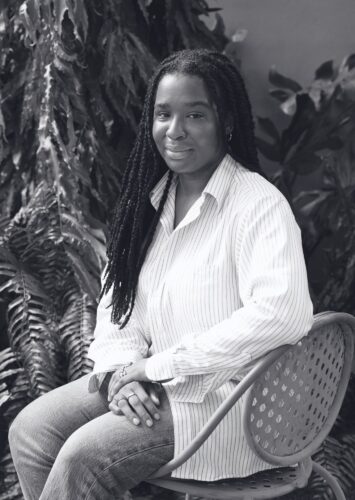
Interview by Megan McDermott
Kat Thompson’s work makes me want to look at my own creative process through more reflective eyes. I suspect this will not be a unique experience. Whatever your creative mediums or goals may be, dwelling with Kat Thompson’s art and wisdom might give you new ways to think about your creativity.
Take, for instance, her willingness to evolve in artistic identity and practice. It’s so easy to get in the habit of thinking of our work or ourselves as only one thing, but hewing too closely to those conceptions may prevent us from blossoming—from moving beyond, as Thompson does, the constraints of a frame or gallery wall (or whatever is similar in your own field).
We might also dwell with Thompson’s commitment to multiplicity and challenging single narratives. As I seek out ways to write from my own experience while also incorporating outside voices and narratives, I am encouraged by artists like Kat Thompson, who show the rich tapestry that weaving together the personal and societal can create.
Most significantly for the poet in me, I sit with Thompson’s description about materials carrying “something . . . palpable,” “a physical and emotional weight . . . that cannot be fully translated into language.” Like many writers, I am often discerning when to lean into mystery and when to make myself clear. Thompson evokes that quality that transcends clarity or lack thereof—the quality that can justify mystery when it otherwise might frustrate: art that is able to make itself felt.
-Megan McDermott, Lead Art Editor

In your biography, you describe yourself as a “lens-based artist.” I’m curious to hear more about how you arrived at that term. Did you need to journey from a primarily photographic understanding of your work to something more expansive?
Within the last year, I began using “lens-based artist” to describe my approach. It became more accurate as I started to think of the camera less as a tool for producing a single image and more as a way to visually capture and narrate ideas. I’m interested in how a photograph can function as an art object—something that can be shaped, placed, and activated in space.I started in a more traditional photographic framework, working primarily in portraiture, and didn’t imagine the work expanding beyond that. This shift really began as I started researching my Caribbean heritage, which opened up questions around memory, landscape, and diasporic histories that exceeded what a single photograph could hold. Graduate school became a catalyst for deepening that transition, both in how I think and work. I began incorporating sound, textiles, video, archival materials, and site-based installations—not as departures from photography, but as extensions of it. Photography remains central, but as a point of departure rather than a fixed endpoint.
Something I thought a lot about with your work was the relationship between creation and curation, and the idea that curation itself can be a kind of creation. A literary parallel for our Blackbird readers might be found poetry or erasure poetry, which works with materials already out in the world, often to bring to the surface what has been overlooked.
What is your process like in terms of finding archival images, postcards, souvenirs, personal photos, etc., that feel right for your projects? Is there an aspect of working with found materials that feels the most creative or generative for you?
I think of curation as inseparable from creation in my practice. They’re twinning. The act of selecting what to keep, repeat, and place in relation to something else is already a form of image-making. Working with found materials feels very close to something like erasure or reconstruction, where the meaning is shaped through attention and framing.
My process of finding materials is both intentional and intuitive. It begins from a gaze of curiosity. A part of the research is learning, or rather relearning, aspects of my culture that I kept at a distance for a long time. I have become especially drawn to certain time periods that shaped the identity of Jamaica, and I often source ephemera from those moments. I spend time in archives, markets, and online spaces, but I am not searching for something fixed. It is more about recognition: an image, object, or text that holds a certain visual, historical, or emotional charge. Alongside that, there is a desire to think about nationhood through domestic materials like family archives that are not my own.
The most generative part for me is the moment of recontextualization. When I bring these materials into new relationships, placing them within landscapes, layering them with sound, or incorporating them into installations, they begin to shift. They can reveal absences, tensions, or overlooked histories that were not immediately visible before. That process feels less like preserving the archive and more like activating it, allowing something latent to surface.
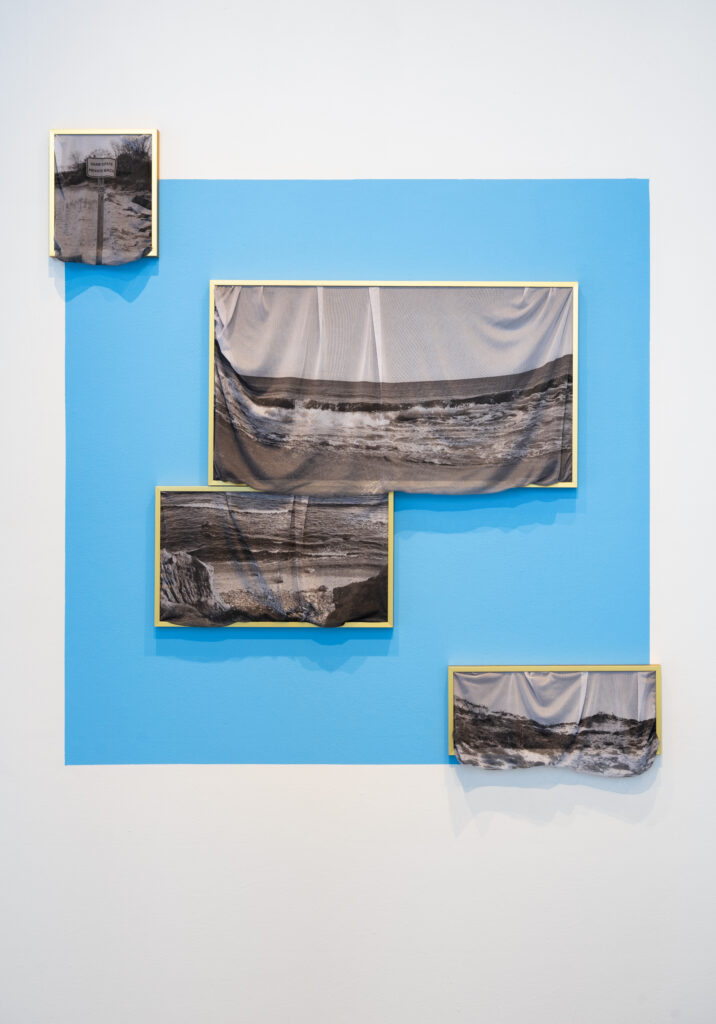
You mention the importance of recontextualization. The way you create context—through a bright blue frame, a photo printed on fabric, or including an image in a larger-scale collage, as is the case with The Weight of Paradise—is one of the most striking aspects of your work. How do you think about context, and who inspires you in that thinking?
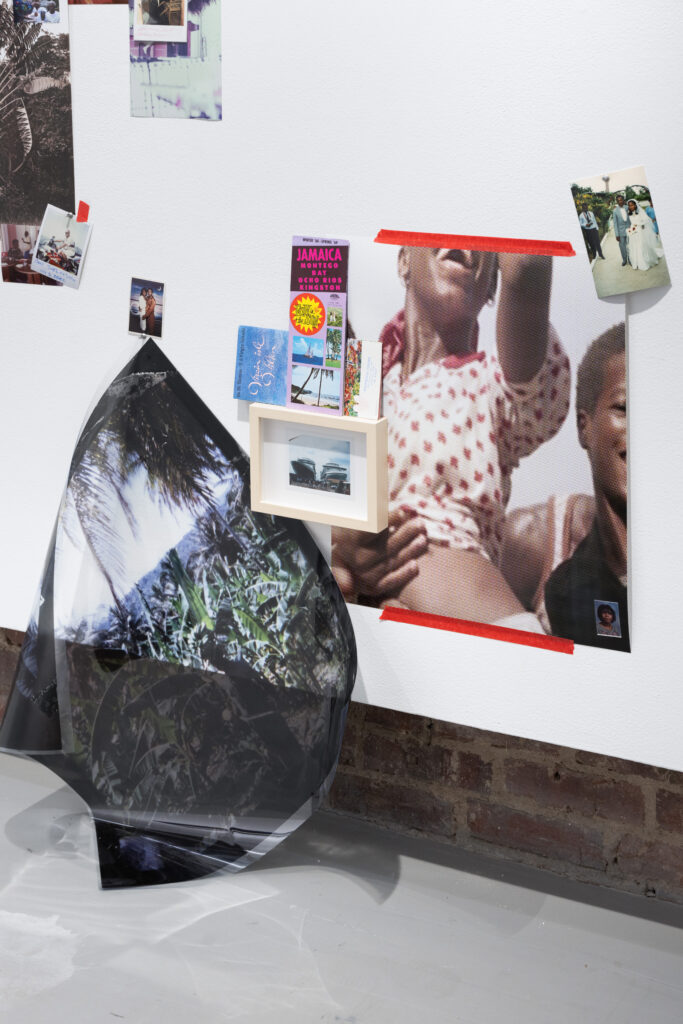
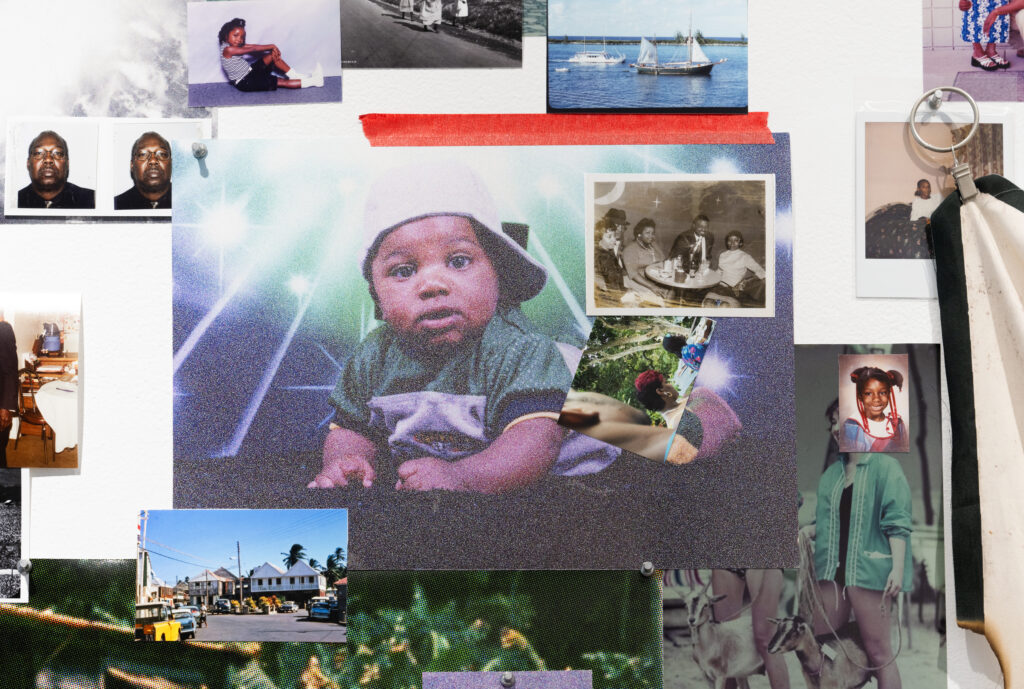
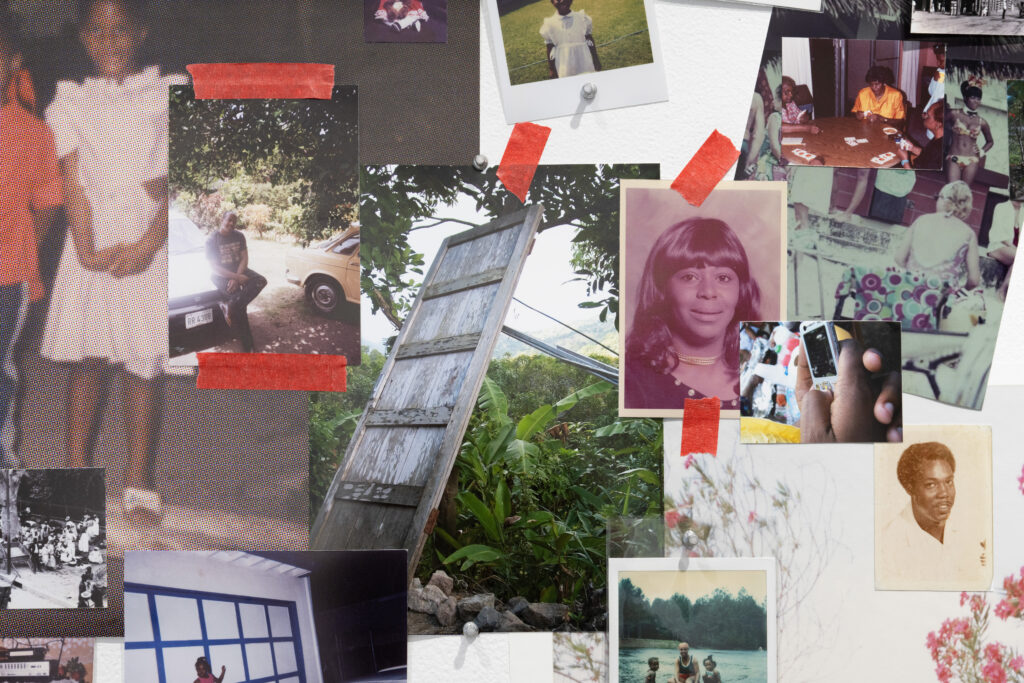
I often think of the image as something unstable on its own, where meaning is produced through the environment it is placed into. A photograph can shift entirely depending on what surrounds it, how it is scaled, what material it is printed on, or what it is placed beside. Those decisions are not secondary for me; they are part of the image-making process itself. With works like The Weight of Paradise, I am interested in how juxtaposition and accumulation create a kind of visual pressure. The image begins to speak through relation, tension, and proximity.
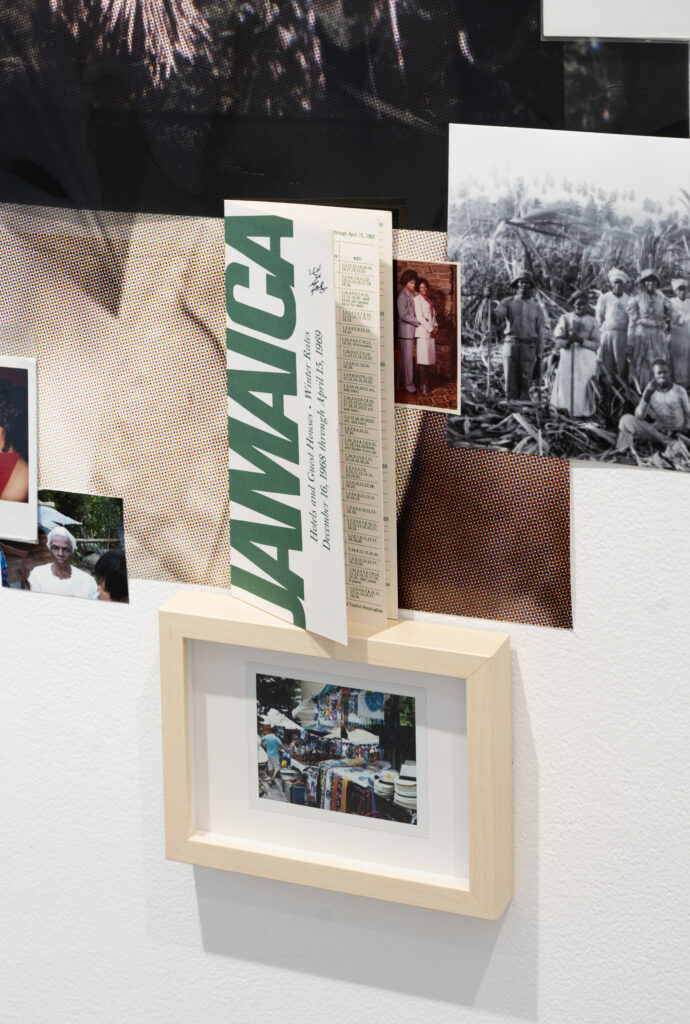
The Weight of Paradise brings fragmented memories and historical imagery into relation through red tape and silver pushpins. The work became a space where different types of materials could loosely hold together: photographs I took in Jamaica, images of my family, photographs of people I sourced online, along with physical and digital ephemera such as brochures, postcards, and other archival fragments. It became a convergence of everything I had been researching and thinking through, and a way of situating those materials within the complex history and narrative of Jamaica.
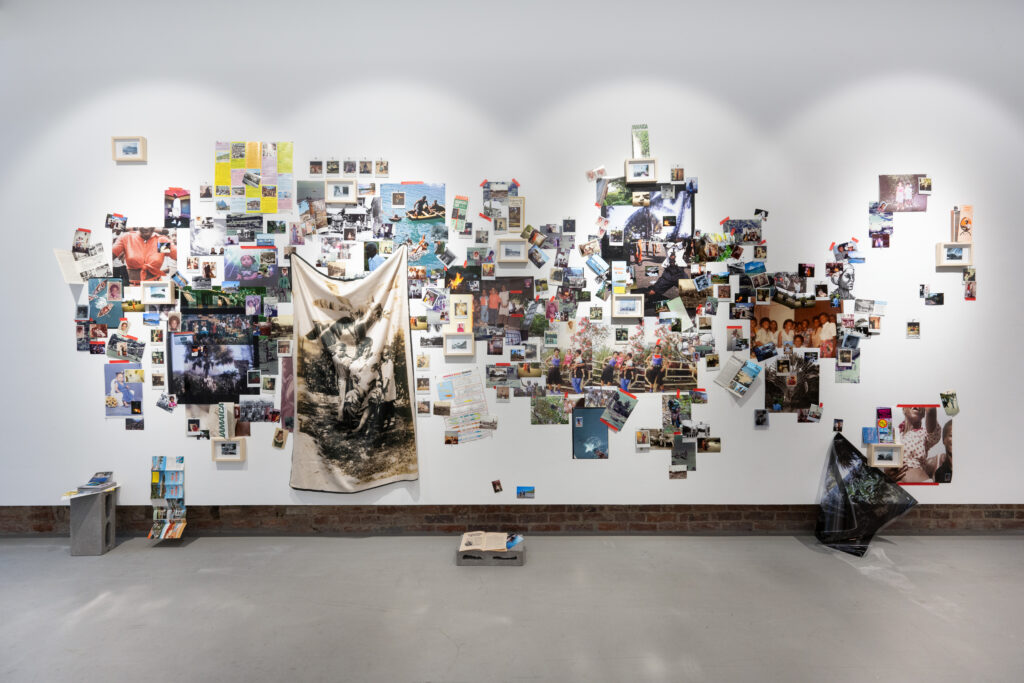
For me, the piece also became a literal unveiling of the weight and cost of paradise for those who are from the island, while those who arrive for leisure are able to leave while taking fragments of both the land and its people with them. There is a reversal of tropicalization at play, where the viewer is confronted with what sits beneath the picturesque surface. That tension is something I am interested in holding in the work, where beauty and extraction exist at the same time. In terms of influence, I am drawn to artists who treat installation and sequencing as an extension of photographic thinking. Lorna Simpson uses repetition, text, and installation to create layered readings of identity and memory that are never fixed. Carrie Mae Weems is another key influence, particularly in how her work moves between image, text, and space to construct narratives that feel both personal and collective. And I can’t forget the most significant influence . . . Deana Lawson. I consistently return to her work, whether her assemblage-based installations, her large-format photographs, or her writings. Her presence as a prominent Black woman photographer within the contemporary field is amazing to witness in this time, especially in how she constructs images that feel both intimate and monumental, staged, yet deeply rooted in lived experience.
The monumental is a significant concern in your work as well. In the description for your exhibit Soft Monuments, you articulate a desire to create a “counter-approach” to “state-sanctioned” colonial monuments in the Caribbean. I’m interested to hear if your time studying in Richmond, Virginia (home, in recent years, to intense controversy over Confederate monuments) for your MFA contributed to your thinking about the monumental and challenging conventional monuments?

Yes, being in Richmond did shape how I think about monuments, even if indirectly. There is a very visible relationship to monumentality there, not only in the presence of Confederate statues, but in how public space has been structured around what is preserved and made to feel permanent. What stood out to me most was how fixed those narratives are meant to feel, while actively being contested. The monument is designed to project stability and authority, but it also exposes how fragile those narratives are, since they require constant protection and public maintenance in order to remain visible.
That tension stayed with me. My focus in Soft Monuments is on challenging the idea that memory has to be monumental in order to be legible or even important. In the Caribbean context, colonial monuments often function as imposed structures of memory that do not reflect the complexity of lived experience. This led me to think about monumentality through fragility instead, through materials that shift, degrade, and depend on community care. In thinking through Caribbean contexts outside of statues, I began considering what other diasporic materials might function as monumental. Public memory is never neutral, but always actively constructed and actively on a path of being dismantled.
Related to your use of materials, I was especially fascinated by textiles in The Archive is Soft. The fabrics could be seen as obscuring faces and individuality, but they also could also be interpreted as revealing something vibrant and colorful. What do you hope your work helps reveal, if anything, about the people and places you feature? What do you think makes for a revealing piece of art?
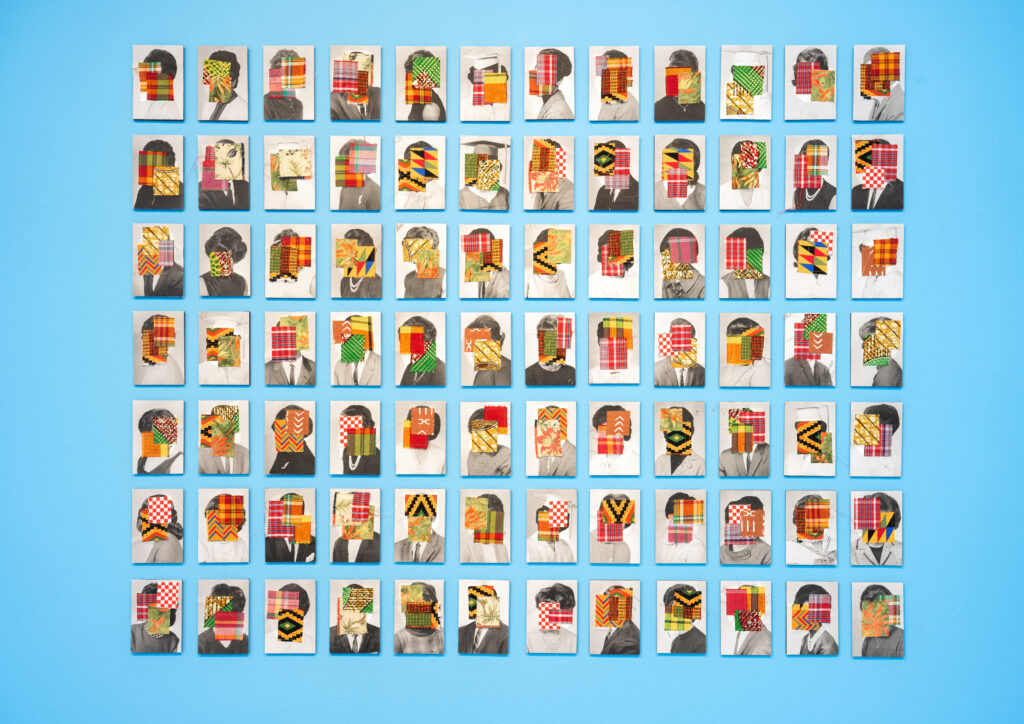
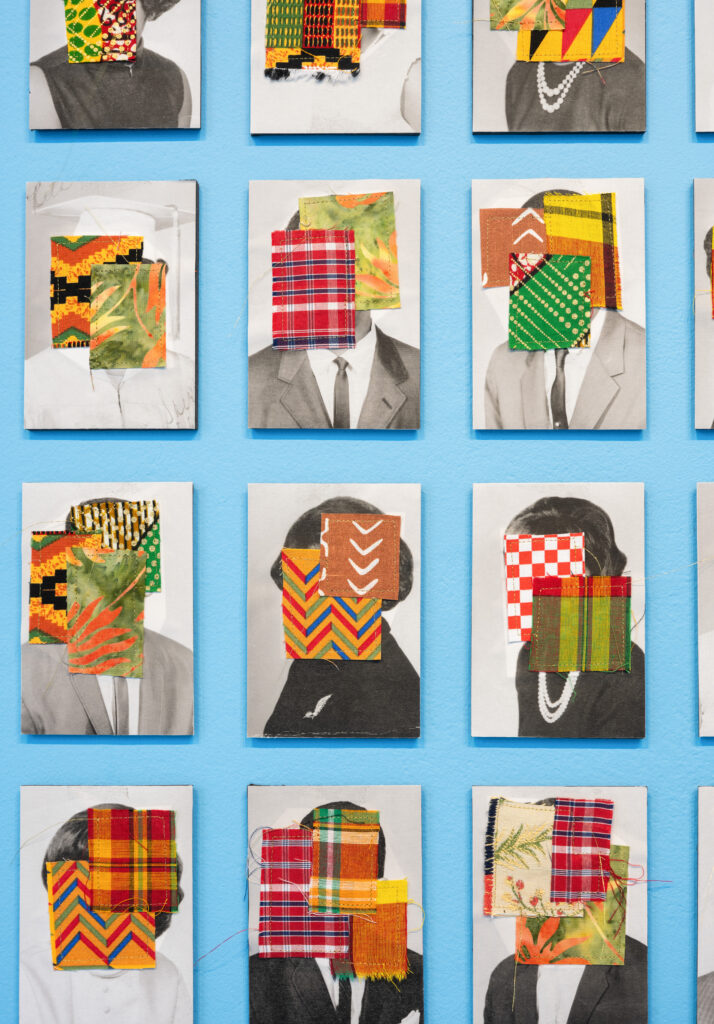
The Archive is Soft consists of high school photographs from the 1960s, taken in Motown-era Detroit, Michigan. I was drawn to these portraits because they already carried a kind of openness, which gave me space to experiment with manipulation and recontextualization. In The Archive is Soft, I think about how the photographic archive can be held, interrupted, and reactivated rather than simply displayed. Textile becomes a way of doing that. It can obscure the image, but it can also reveal something else, in this case an emotional presence that the portrait alone might not carry. The frayed edges and hanging threads reinforce that idea of process and impermanence.
In earlier work, I began using fabric as a way to intervene directly into the photographic surface, layering madras prints, particularly the Jamaican bandana Madras, alongside other Caribbean textiles and commercially produced “African” wax prints found in big box craft stores. That combination became a way of thinking through gatekeeping within the Black archive and how identity is constructed, circulated, and sometimes contained through material culture. Including “African” wax prints was important to me because it points to how culture can be commodified and detached from its origins while still being consumed as authenticity. Placing the Jamaican bandana alongside these other textiles becomes a way of inserting my own positionality into the work, and of speaking to a diasporic condition that is layered, shifting, and non-linear.
For me, a revealing piece of art is about creating conditions where something can surface that was not immediately visible before, whether that is an emotional residue, a historical tension, or a shift in how an image is understood through relation.
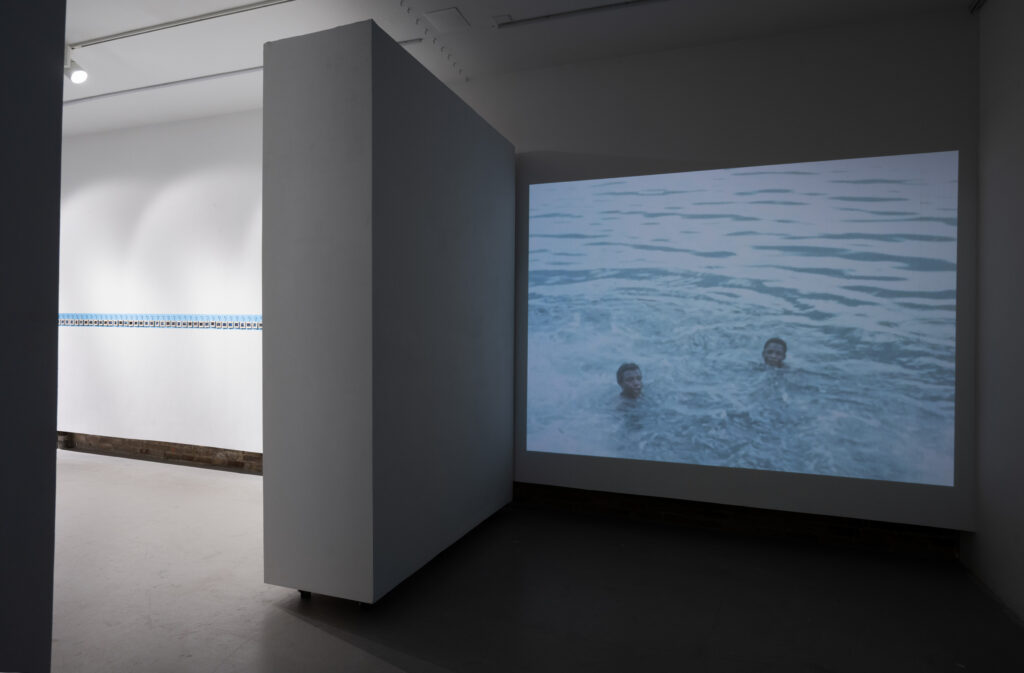
While viewing your work, someone might wander from Souvenir of Access—tiny images that invite a close-up gaze—to a video installation projected on a wall, like Gaze, Interrupted where its subjects are life-size or larger than life. What do these variations of scale offer? Where do you instinctually gravitate?
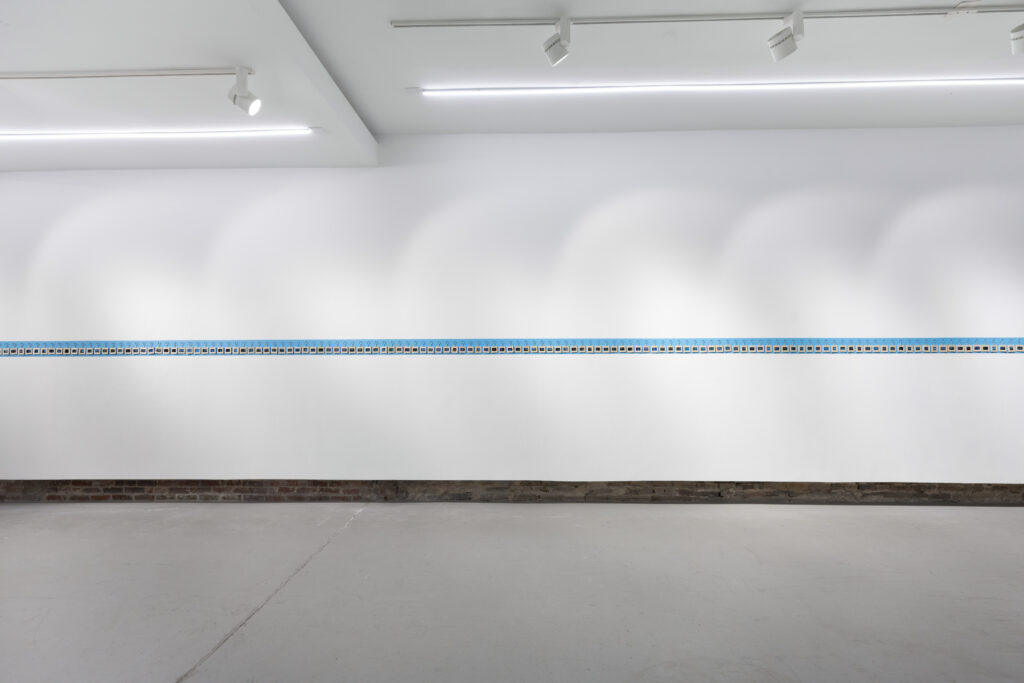
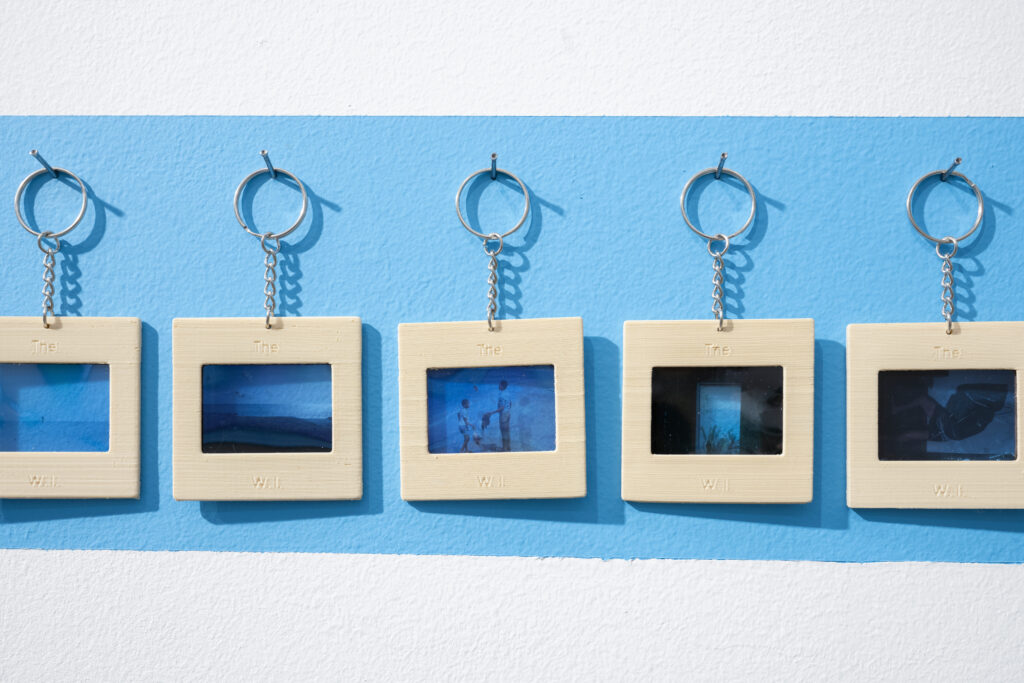
Scale is one of the ways I think about how an image is experienced in the body, not just seen. Shifting scale changes the viewer’s relationship to attention, proximity, and time. With something like Souvenir of Access, the 3-D printed keychain asks for intimacy. It requires the viewer to physically move closer, to slow down, almost to enter a one-on-one with the image that can only be viewed through the blue hue behind them. In contrast, something like Gaze, Interrupted or The Weight of Paradise expands outward and becomes immersive and confrontational in a different way. The body is no longer approaching the image, it is being held within them.
Scale emerges from what the work is asking for. Some ideas need closeness and subtlety, while others need accumulation and excessive pressure in order to be fully felt. Small-scale works can hold a kind of quiet intensity that feels almost private, while large-scale or installation-based works allow for fragmentation, layering, and contradiction to coexist.
Another phrase that really jumped out at me in reference to your work, is “vernacular photography,” which MoMA describes as “an umbrella term used to distinguish fine art photographs from those made for a huge range of purposes, including commercial, scientific, forensic, governmental, and personal.” How would you describe the power and potential of “vernacular photography”?
I think vernacular photography is powerful precisely because it refuses the hierarchy that places “fine art” photography above everything else. It is often made outside of art contexts, which does not make it any less constructed or meaningful. In fact, it carries a different kind of intimacy because it was never necessarily made to be interpreted as “art” in the first place. What draws me to vernacular photography is that it holds traces of everyday life, family, labor, documentation, celebration, absence, and memoriam. It is often where history exists in its most unpolished form.
My own introduction to vernacular photography came when I started incorporating family photographs outside of my own archive. I was surprised, and also moved, by the similarities I began to notice. There is a shared visual language of Black life, even when the experiences are geographically and culturally distinct. I could see echoes of my own history within images that were not directly mine.
In relation to the art world, vernacular photography asks us to reconsider what is already present and already speaking, even if it has been overlooked or deemed “boring.” I am thinking here about the writings of Tina Campt and Krista Thompson, especially how they both frame images not only as visual objects but as carriers of the circulation of Black social life. Campt’s attention to the quiet, everyday frequencies of images and Thompson’s work on visibility, display, and the construction of Black visuality have been important in how I understand vernacular photography as something active rather than static.
Within my practice, vernacular photography becomes a way of thinking about the Caribbean and Black diasporic experience as something already documented from within, not just through institutional or colonial lenses.
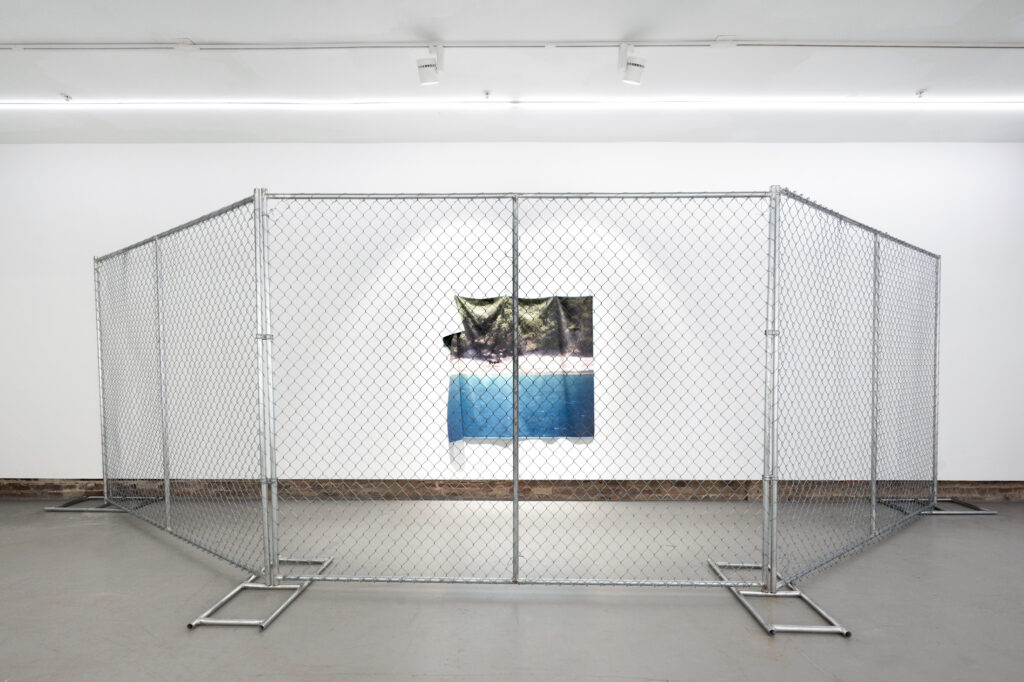
You’ve written about your art: “My work builds material and visual spaces in which Black and Caribbean presence is neither consumed nor explained, but sustained through care, complexity, and agency.” Have you ever felt pressure as an artist to offer up Black and Caribbean experiences in ways that were more consumable or explicable? What supports you in resisting those pitfalls or temptations?
Yes, that pressure is very real, both within institutional contexts and in more informal expectations! It can feel like there is an expectation, especially when working with Black and Caribbean subject matter, that the work must translate experience in a way that is immediately legible or easily consumable. I like to say “digestible,” if I’m being real. I have felt that tension, particularly around how quickly complexity can be flattened into narrative. There is sometimes a pull toward making work that resolves itself too neatly, or that performs a kind of explanatory role. But I am not interested in resolving those experiences in that way. Black and Caribbean histories are not singular or easily contained, and I do not think the work should pretend otherwise. I do not want to be an artist who consistently reproduces a kind of falsehood or romanticized image. Yes, the islands are beautiful, but I am more interested in breaking down that picturesque veil, because the Caribbean also carries a complex and often violent history that I want to continue to explore more deeply.
This connects to ideas in Jennifer Doyle’s Hold It Against Me. Rather than seeing discomfort as something to smooth over, she frames it as something productive, something that can hold emotional and political weight. Difficult or controversial approaches can be misread as inaccessible, when in fact they are often asking for a different kind of attention.
What supports me in resisting is returning to process and material. When I am working directly with images, textiles, archives, or installations, I am constantly reminded that these materials already carry their own opacity, but also something more palpable. There is a physical and emotional weight to them that cannot be fully translated into language.
Resisting that pressure is less about rejecting communication altogether and more about protecting complexity and allowing Black and Caribbean presence to remain layered, shifting, and unresolved on its own terms.