That autumn, I tried to love an engineer who bragged about never needing braces. My teeth are straight, always have been. See? He pointed at incisors that tilted inward, but I agreed he was perfect. I needed the engineer to love me. I wanted to love him back. I was thirty-something and a PhD candidate, still hopeful. I wanted to be a professor and I wanted children. I didn’t care about crooked teeth. I taught college students, but dreamed of teaching my own about the seasons—how ancient people feared that darkness would be permanent. They braced for loss. I did too, as a child, dreading the Ohio dome-cloud that came for us in November and hovered until equinox. I scoured my backyard for the brightest leaves and flowers, saving them between the pages of heavy books. A rose petal lodged in my American Heritage; a maple leaf, its veiny underside crisp, pressed against Ephesians. I am still finding evidence, today, of things I preserved against time. But what would I have told children about another man’s menagerie—the exotic animals he kept caged in Muskingum County? On the day he decided to kill himself, he opened their cages to set them upon his neighbors. The animals heard the gunshot and stepped forward, nosing open unlatched gates. Bengal tigers, wolves, grizzly bears. Baboons. Giant cats, set loose, mauled the man’s body. Others devoured two small monkeys. But the rest pushed on, moving toward hills they mistook for bigger hills. When I told the engineer about the animal escape, he acted like he didn’t know. Hadn’t heard. Couldn’t imagine a giraffe listing toward us, its bowlegs arching like a scarred tree, or a wolf chasing a frostbitten firefly, or a gazelle grazing the sweet rot of cornstalks. It didn’t matter anyway: by the time the news went national, the animals were dead, gunned down, bodies laid belly-to-back in a field. Snipers had assembled before the sun hit its slant; police had perched flashing signs on the shoulder of I-70: Caution exotic animals stay in vehicle. Not one was spared. They had to be killed—you cannot let tigers wander the suburbs, or wolves stalk pets. Children were kept home; schools were closed. Nothing we could do, Jack Hanna told Diane Sawyer on the nightly news. They couldn’t be tranquilized. That fall, the engineer took me places: Oktoberfest, football game, bonfire, holiday office party. He leaned his head on my shoulder during reruns of Quantum Leap; he thawed for me a casserole his mother had made. When he was a child, he said, his mother had collected him from school each day at noon, brought him home for a warm lunch, and then returned him to class. I asked why she’d done that. Because my childhood was awesome, and she wanted it that way, he said. With me, he hoped that awesomeness would multiply. He took me to Jack Hanna’s zoo to see the Christmas lights, converted to LED for the first year ever—unnerving, preternatural hue. Better for the environment. The animals hid from the glare, their kinship a cloud. No wolf bayed, no tiger emerged to paw frozen mulch. Only solstice set in. That night the engineer set before me a choice: Would you rather have a family or travel the world? I laughed. I thought of a daily hot lunch, a minivan, a school I would have to drive to and then home and then back to again. I chose not to choose: Why can’t I do both? We stopped talking and parted ways. You shouldn’t laugh when you don’t know the future: I’d get my degree but not a career; I’d never earn enough to travel; I’d get along without seeing the world. And I wouldn’t have children—not anyone’s, not ever. Phantom accident, lidded luck. No one else put before me a choice that would billow into a child; a child to show my crisply pressed mums; a child to guide by hand through the zoo’s Heart of Africa exhibit to see a bowlegged giraffe, a swollen rhinoceros with arthritic knees. Perhaps it’s better this way, to be without and then with, and then without again. Yellowing pages tell of sacrifice enough. As do Ohio hills, bog swamp and silt. So what if I have no one to show the sun’s slant, the narrowing of days? No one to take to the hills, to point out the land that the animals trusted, if just for one day, until they were discovered. When they left their cages that morning, they didn’t know the meaning of carnage, what it was to be unsafe. Nor do the never-born, who belong to solstice always and always-after. Only those we let loose in this world can see these hills, anchored as if by accident, and know what the animals saw.

Blackbird
An online journal of literature and the arts
close
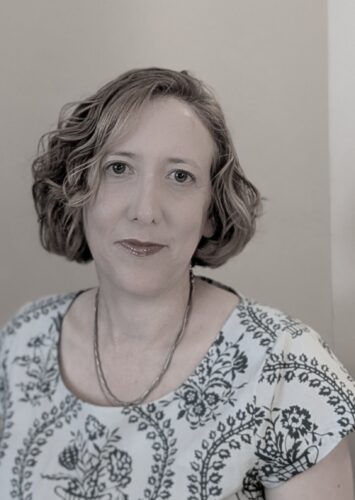
Kristina Garvin
Kristina Garvin lives in Philadelphia. Her work appears or is forthcoming in North American Review, Salamander, Barrelhouse, The Forge Literary Magazine, and elsewhere. Originally from Ohio, she holds a PhD in early American literature and currently works in the public health sector.
Footer
Sign up for our Mailing List
Support Blackbird
Founded in 2001 as a joint venture of the Virginia Commonwealth University Department of English and New Virginia Review, Inc.
ISSN 1540-3068

Virginia commonwealth university
Blackbird
VCU Department of English
PO Box 842005
Richmond, VA 23284-2005
Virginia Commonwealth University is a nationally renowned public research institution dedicated to the success and well-being of all members of its community. VCU student, faculty and staff groups and associations are open without regard to any characteristic or identity protected by law.