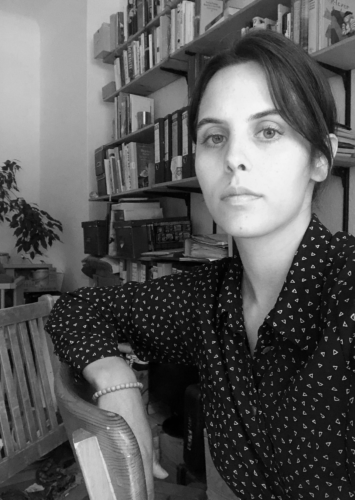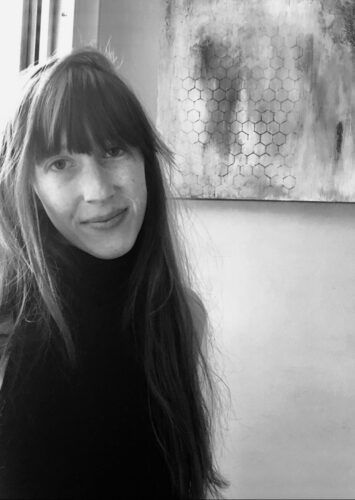
In December of 2024, Margaret and I spoke on the back patio of Workhorse in Austin, TX, about her debut collection of poetry, Nowhere Was a Lake. She told me about the process of shaping her poems, her influences, the New England landscapes, and family stories that inform the collection. We talked as well about domesticity and wildness, shrinking and expanding bodies, and how the book came together over the course of a decade.
By the time of the interview, Margaret’s book had been out for the better part of a year, and she had already begun to turn her thoughts elsewhere, toward a new collection forming around themes of addiction, somatization, and recovery. Listening back to our recording, I noticed that certain rhythms emerge as she reflects on her process of writing Nowhere. That decade of writing had been constant, sustained. But it was always punctuated by other people—their necessary interruptions, their entries and departures. At first glance, Nowhere Was a Lake may seem to revolve around a series of relationships that impact the life of a young woman, but what hovers just above the surface is a poet’s fidelity to her craft; to stepping outside of herself and, no matter the discomfort, looking in.
Anna Vilner
The title of your collection comes from “Bluegrass,” the Carl Phillips poem you quote in your epigraph. What drew you to this poem?
Margaret Draft
Probably its economy. It’s not as sweeping as other poems Phillips has written—how he embeds clauses within clauses, questions within questions, an elliptical structuring that at first seems meandering, easy to get lost in—but it invites a similar spaciousness that affords the reader greater mileage without moving an inch, which feels distinctly “Phillipsian” to me. “And he told me nowhere was a lake that, / any day now, he’d surely drown in.” This could be interpreted in one of two ways, right? On one hand, you could say that the lake exists, that there is a lake called Nowhere. On the other hand, you could say that there is no lake, that there never was a lake to begin with. Its existence comes into question. Figurative or not, the implication is that there’s so much more beneath the surface of what we say and choose not to say. What we suppress or witness. What we choose to live with.
AV
Who or what were some of your other influences for this book?
MD
“The Guest,” by Anna Akhmatova. Proffer’s translation. It’s such a striptease! Tonally, it’s sexy, taunting, a bit foreboding. The slow and controlled pacing also almost perfectly imitates the caution or resistance to an affair just before you leap. It’s an incredibly seductive poem. Also, I read it at a time when I was struggling with my self-concept and identity as a married person exploring polyamory. I had a difficult time consolidating myself to the idea that I could be and do both. Even if what I was doing was consensual, some part of me felt I was being unethical. Of course, I was socialized to believe this. I won’t get on that soapbox. The point I’m trying to make is that this poem guided a lot of my thinking around how to frame or pace that particular tension, or some of the competing preoccupations people are so often privately seized by: temptation, shame, restriction.
James Wright was another influence. His poems taught me that you can say significantly more with less. His work also influenced much of my thinking around strategies for exit. “Lying in a Hammock at William Duffy’s Farm in Pine Island, Minnesota” is a poem I invoke far too often! I love the fact that the bulk of this poem is an exhaustive list of prepositional clauses where the speaker’s lying in a hammock describing the different data points of his surroundings. You almost forget the speaker’s even present, looking at horseshit, until you reach that final simple declarative: “I have wasted my life.” Ironically, it feels earned, even if hardly labored for.
AV
Let’s talk about the landscapes of these poems. Vermont, and New England more generally, maintain a very strong presence. There are recurring mentions of animals, both domestic and not, and the flora of the region. Cultivated flowers, wildflowers, too.
MD
Absolutely. I’ve always been drawn to the northeast, especially remote, bucolic landscapes. My mother grew up on a dairy farm that’s still quietly tucked into the Green Mountain National Forest. Terrific place to get lost in. Not to mention, the property’s been in my family for six generations, which is insane, both burden and blessing. It predisposed me to indulging a little too frequently in feelings of loss or romanticizing situations that don’t share its same signature of continuity. It’s of a bygone era.
AV
You grew up in Chicago, but you’ve always seemed to be captivated by these quieter landscapes.
MD
Definitely. I wrestle with this 24/7. I feel like an urbane milkmaid. I strain for anonymity and the accessibility of cities. Everyone knows your business in a town or small city. Salacious gossip abounds. But I’ve spent seasons working on farms, nursing the fantasy that, indeed, I do live in a period piece, never needing more than the sanctuary of my own wistful, idle thoughts.
AV
Urbane milkmaid. That’s how I’m going to describe you from now on.
MD
Please do!
AV
So, it was always part of your upbringing, this back and forth between the city and the farm in Vermont?
MD
I’d say so. My mother brought me and my siblings there nearly every summer until I was a teenager. I then spent a few summers on the farm when I was in college, offering occasional help with fowl or in the pickle patch. One summer, I totally drowned those bloaters . . . or I left them high and dry to bloat. I can’t recall which. It wasn’t intentional. I was distracted, chasing some sweet farm boy in Pownal. Needless to say, I haven’t been tasked with many farm chores since.
It wasn’t until 2021 that I finally moved to the farm and began living in a studio apartment that’s an old carriage barn. I have to pinch myself sometimes, it’s so beautiful. But I continue to live in denial about my place, space, role. Unlike my cousins, I have the freedom to come and go from the farm. “Colic,” the first poem in the collection, alludes somewhat to this denial or the responsibility of having to be one of its custodians. Animals arrive and die. My cousin, Donald, is the one who has to bury the animals. Wield the shovel, approximate a grave.
AV
A very striking image.
MD
Totally. I gasped when he told me the story. Again, Donald’s a farmer, not an urbane milkmaid. His perspective is significantly more pragmatic than my own. You need to be, as a farmer. Regardless, that image seemed to me too good of fodder not to write about because it resonated with me in other ways. I think it’s human nature to step into the grave of a thing, a thought, a feeling, chew the cud. My poems attempt to address the madness in that “ruminating” process.
AV
They deal with going below the surfaces of things. The speakers go below the landscape, under the dirt, into the water.
MD
Subterranean life. You also mentioned flora before. There’s a poem in the collection called “Floriography” – how Victorians used flowers to express their feelings indirectly. Even though so much of my writing is direct, I leaned somewhat on their symbology to express what I wanted to say without ever saying it.
AV
From my familiarity with some of your reading habits, I know that you used to have a fondness for Victorian literature. There was a time when you studied it. Is that still an influential canon for you?
MD
Yes and no. There’s a repression in the Victorians that I both admire and am allergic to. Then again, I rather enjoy language that feels a little repressed or anguished. Maybe I enjoy feeling a little anguished. Anguish can be generative.
AV
One thing we haven’t touched on is the cover of the book, which you helped design. Tell me about your interest in collage.
MD
In a way, poetry and collage seem like the same medium to me. They both invite juxtaposition within their respective containers. I love paratactic syntax for this reason. Like collage, parataxis lends itself to play; cutting, pasting, or reordering lines in ways that can feel both disjunctive and exciting.
In any case, early in my first marriage, I was obsessively cutting out images from old National Geographics, trying to make sense of something that felt sacred but nonsensical to me. I found the image of the lake in one issue, then the image of the woman in another. Instinctively, I thought to displace her. I wanted to disrupt her environment or situate her in her wildness because some part of me felt wild or trapped by the seeming constraints of my own domestication or some of the more practiced prescriptions of what it means to be a married person. I was becoming increasingly disinterested in traditional scripts of gender and marriage.
AV
Yeah, she looks very much like she’s tending to the men in the boat, but the proportions are manipulated so that she’s a giant compared to them. She’s not dominated by the landscape.
MD
Right. Is she steadying the boat? Or is she the sea monster capsizing it? Who’s to say which. Either interpretation feels accurate.
AV
Maybe we can look at “Story About a Body,” too, because it has to do very explicitly with the opposite, with shrinking oneself.
MD
I shrunk that poem to its skeleton. It was longer before. On some level, this poem deals with my relationship to my own body and continued stigma around eating disorders. More specifically, the psychological, relational, and physical ramifications of those. On another level, this poem’s invested in disappearances, disassociation, or performance. Performance for an audience. Performance of the body, love, ego. More often than not, we don’t even realize when we’re performing. I figure this is in large part because we continue to divorce the mind from the body and so much to our own detriment. Even when there are studies that prove that what we think or feel manifests in our bodies as physiological symptoms.
AV
Many of these poems are autobiographical. Or rather, they contain a seed of autobiography, something that was said to you, for example, and then you build the rest of the poem around it. Is this generally your approach?
MD
I can’t say whether this is always my approach. Then again, you know me. I’m not especially shy when it comes to disclosing my own emotions or experiences. My logic is that people connect through a shared fragility or fallibility. At the end of the day, I try to honor both when I write. That being said, this collection is almost entirely autobiographical or drawn from my immediate experience or environment. Only a handful of poems are based on events that occurred to other people, even if their lineage or lore informed what I felt or wrote.
As far as my process was concerned, I wrote poems first in prose, if only to dump out the raw material. Then I experimented with lineation. The structure of any poem depended so much on the content. Sometimes lineated couplets felt better suited for a poem where the material dealt directly with a dyadic relationship. Other times, space on the page or breath felt more necessary to animate absence or dissonance. At other times, prose poems allowed me to exploit sentences in ways that felt more liberating, breaking free from the perceived chronology of the line, which can, at times, feel like a formal straightjacket for me.
AV
Speaking of structure, you’ve described the three disappearance poems as being the columns of the collection.
MD
That’s correct. Each section begins with the case of a missing person. There were, as far as I’m aware, five reported “missing persons” or disappearances in the area surrounding my family’s farm during the 1940s and 50s. I elected to focus on only three cases given my professional and personal interest in understanding the effects of triangulation. The people who disappeared were also familiar with the area, which made the disappearances stranger. I guess these stories became a conduit for me to write about or around some of the compensatory strategies I developed later in life, like avoidance, drinking too much, or simply falling off the map just to feel or function.
AV
There’s some experimentation in your collection regarding point of view. In the final poem “Two Tracks,” for example, we enter the lover’s perspective.
MD
Yes, the lover’s now at the literal and metaphorical switch! I felt it was a necessary departure to close the collection at a distance from the speaker’s point of view. A final disappearing act. That shift felt important to end with because the speaker is in some way saying we have to allow other people to make their own choices, even if those choices never offer much closure. Choices are made and unmade, and then other choices present themselves with alarming possibility. We live them out, sometimes with regret and other times with immense delight, sometimes both at the same time. It was a painful but important lesson for me at a time when I felt paralyzed by choice. I was torn between two lovers, two identities, two lives.
AV
A final question, since we’re heading back soon. How do you feel that Nowhere sets the scene for your next project?
MD
I’ve been contemplating how my body lagged so far behind my mind for so many years. I’m only now catching up to it. As you know, I’m in a graduate program to become a therapist. Similar to my poetry, my clinical practice is very much informed by my own experiences. Somatization is something I hope to explore in greater detail in my next collection, along with other themes of addiction, recovery, and resilience. My hope is that this next collection will feel looser, maybe kinder to its speaker. The brain has so many complex circuits. It’s easy to drown in your own thoughts and then blame yourself for having them. We all deserve a little more kindness. To be kinder to ourselves and gentler with others, whatever surfaces.