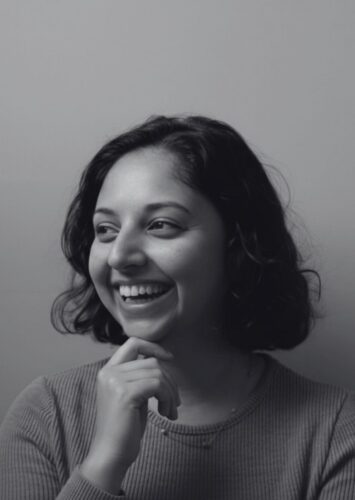
Rabeetah Hasnain:
When I first read your collection’s titular story in Joyland in 2021, I remember thinking, this is how you do it. This is how you write from the perspective of a younger person in a story intended for adults. There is something so honest and trusting about the way younger people think, and I was struck by how much you seem to trust your younger characters, from their observations to their misunderstandings. How do you approach writing younger characters for an adult audience? Is part of the challenge trusting that a character doesn’t need to fully understand what is happening for the reader to understand it?
T Clark:
That was actually the challenge I was thinking about. With “All This Want…” in particular, I was first interested in D’asia as a character, then the situation she was in—I more or less knew the beats. On a craft level, I wanted to explore a story where the audience knows more than the character—I wanted to communicate something sort of over D’asia’s head, but also make it clear to the audience why she made the choices she did and how she got to the position where she’d have to make such choices. So much of writing this book was an exercise in the power of hindsight. The book is fiction, but approximations of the scenarios are real. What do I know now that I would’ve loved to tell myself and other people my age? I certainly know they wouldn’t really listen, but still!
RH:
Reading these stories together, I became interested in the ways your characters watch one another. They watch through videos, at the table, across rooms, in schools, at parties. There is a particular generosity in the way your characters look at one another—they are very perceptive, but also seem willing to let other people inhabit their own realities without judging or correcting them outwardly. I felt this in “Nutcracker,” in“Justin,” and especially in “Walks Like a Duck.” What does it mean to be seen, and what does it mean to be misseen?
TC:
Interesting! I think this is a product of my personal, default lens. I was a quiet kid who grew up around a lot of big energies, so I was always watching adults and people I perceived to be cooler than me for information on how to be. Both “How can people be?” and “How should I be?” Also, “How can I get their attention?” Being misseen is devastating, but there’s a powerful coping strategy embedded. If no one can really see you, then their judgments are baseless and misguided, and therefore they shouldn’t hurt so badly. If a reader tells me they feel seen after reading the collection, I’m elated. It’s the best compliment, and speaks to what I love in books myself.
RH:
I was struck by how attentive these stories are to aftermaths, in which the dramatic event has already happened, and the story tracks what a character does afterward. What draws you to the aftermath rather than the event itself?
TC:
I have evolving feelings about depicting pain. My characters are so often black queer girls, and there’s a particular cruelty in showing such a marginalized demographic going through it. We know how it goes; it’s in front of us every day. I think we know less about what to do, how to cope, what happens when we walk away, how it feels in the long term, etc. You so often hear stories about people who experience sexual assault and don’t even know to call it that for years, for example. The aftermath can be so much grayer than the event itself, so I have more interest in exploring that space. I think I have more to say.
RH:
Years ago, when I was in your writing class, I remember you said: “You only have one shot with your characters, so you gotta put ’em through it.” That line came back to me while reading this collection. Your characters go through some pretty difficult things, but the stories never feel punitive toward them. You never seem to lose sight of their humanity. How do you know how far to push a character? How do you balance the impulse to challenge a character with the impulse to protect them? Has your understanding of that advice changed since you first gave it to me?
TC:
I think this is evolving, too. I’ve never had the urge to kill a character, and that might actually be the line. How much can a person take and still survive? My answer about protection feels contradictory to what I just said about not wanting to show queer black girls going through it, because I don’t really have the urge to protect them inside of the story, either. I think the closest thing to protection is a real, living, human reading the work, and perhaps reconsidering some small aspect of how they move through the world. It’s a tall ask for a debut story collection, but I think it’s part of my writing ethos. If I write enough books, maybe I can make a small dent. I still stand by the advice, though. Let your characters have an experience!
RH:
I’m always interested in conversations around short story collections and short story cycles, and I certainly see these stories speaking to one another thematically. What do you hope readers notice about the collection as a whole that they might miss when reading the stories individually? Does the order of the stories reveal something to you about the collection that you don’t necessarily see when you’re writing the individual stories?
TC:
This is a bit of an adjacent answer, but while putting the stories together, I was a little concerned that I wrote the same story thirteen different ways. I’m glad to hear that that’s not everyone’s experience of reading it. A potential takeaway is that this energy around power dynamics, taking advantage of each other, what we’ll do when we’re desperate for care, etc. is pervasive, and maybe more understandable than it appears on the surface.
RH:
What are you working on now? What’s next for you?
TC:
Life-wise, I started teaching at LSU New Orleans in August, which has been dreamy. It’s such a privilege to be in a room with people who are dedicated to using their brains to try to say something they deem important. I’m writing a novel! The narrator is an adult for most of it. The horrors persist, but so do the jokes.