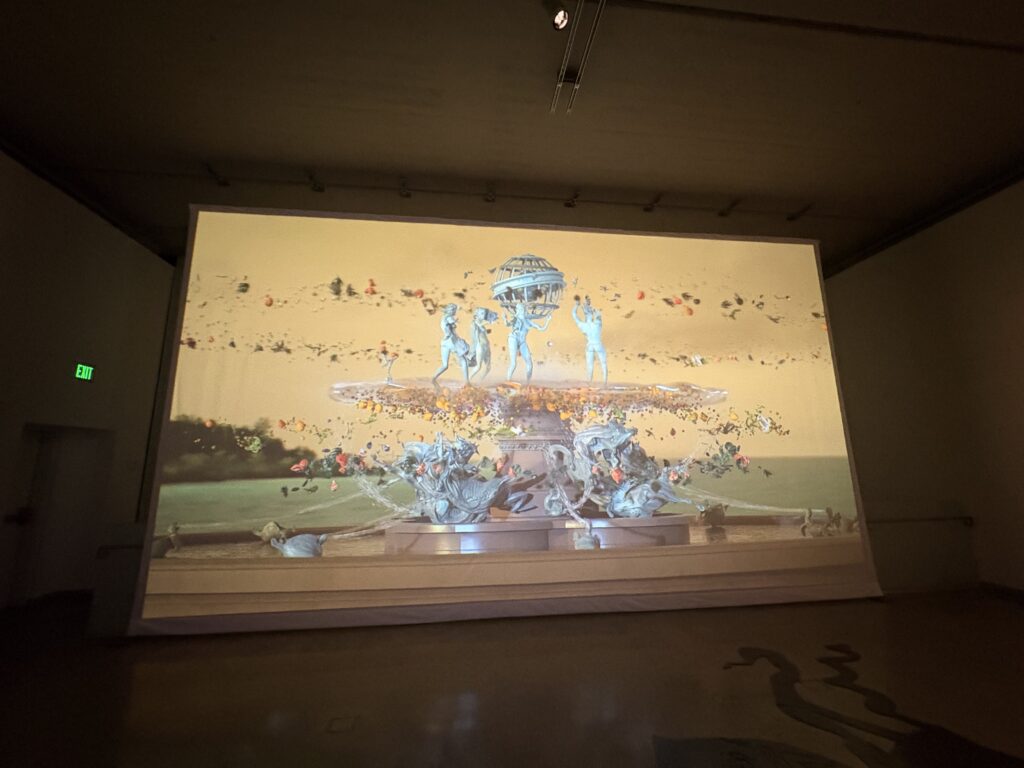
Attila cataract your source at the feet of the green peaks will end up in the great sea blue abyss we drowned in the tidal tears of the moon was on view at the Institute for Contemporary Art at Virginia Commonwealth University through February 22, 2026 as part of the exhibit’s North American tour. More of Creuzet’s artwork can be viewed online at https://www.juliencreuzet.com.
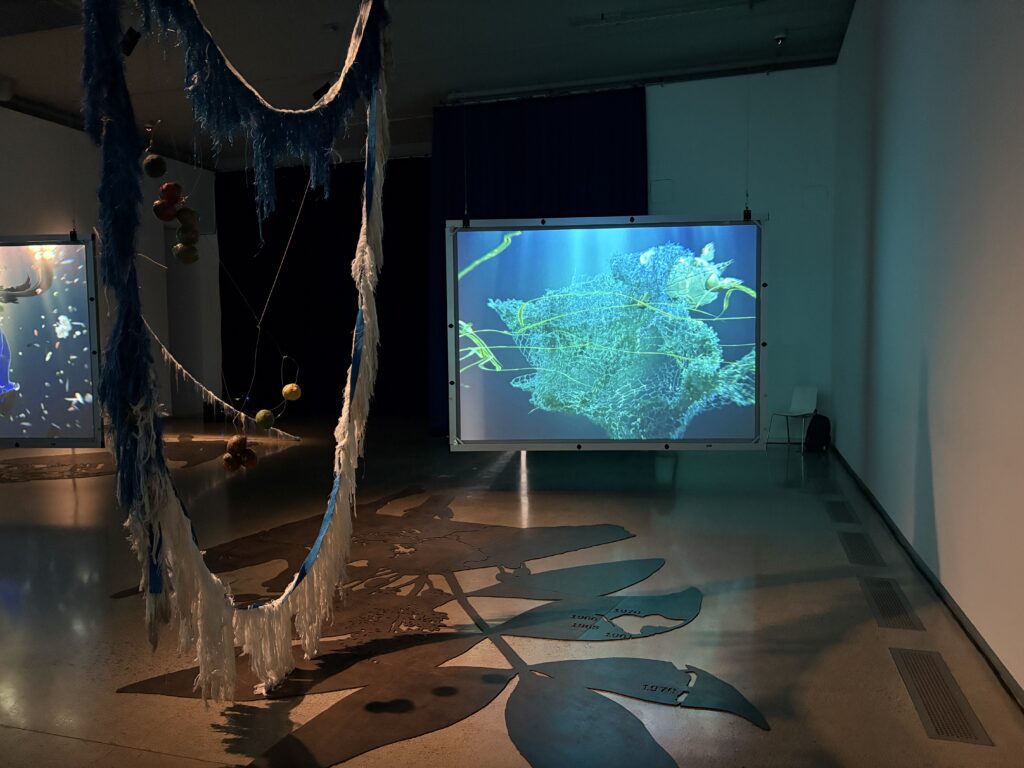
My first thought upon entering Julien Creuzet’s exhibit at the Institute of Contemporary Art in Richmond, Virginia is Where do I look? After passing through a thick, blue curtain, attendees are immersed in sensorial overload. Music pulses in a dim space as several videos play across spread-out screens; sculptures dot the gallery, incorporating nets and amorphous shapes, while maps rise out of the floor.
Maybe the more apt question is How long should I look?
The answer: always a bit longer than I first assume.
In one video installation, a cherub-like figure floats underwater by a chandelier, firmly establishing a surreal setting—until you catch sight of a cell phone floating past. Across multiple videos, reality interrupts; dream and destruction merge. Creuzet’s work is populated with turtles caught in nets and fantastical creatures who might be variously read as aquatic fairies, angels, or aliens, as well as figures inspired by classical sculpture. A video of a green gelatinous figure floating upwards evokes, at first, a sacred figure, but if you watch long enough, you end up seeing trash. Through this moving water motif, Creuzet constructs something ever-shifting and multiple.
This aspect of Creuzet’s work calls to mind Virginia Woolf’s classic experimental novel, The Waves. Juxtaposing the lives of six friends with vignettes of a seascape’s unfolding through time, Woolf returns again and again to the language of water, evoking the instability at the heart of human experience. As Rhoda, one of The Waves’ main characters, says, “Like a ribbon of weed I am flung far every time the door opens . . . I am the foam that sweeps and fills the uttermost rims of the rock with whiteness; I am also a girl, here in this room”(77). For me, the exhibit physically embodies the existential predicament Virginia Woolf tries to capture, of being both aware of one’s self and feeling an uncanny kinship with something beyond one’s self. In front of Creuzet’s water scenes, I, like Woolf’s Rhoda, am aware that I am a person in a particular room (in this case, an ICA gallery), while also feeling the pull of dissolution—the feeling of being swept and flung, of being foam or seaweed.
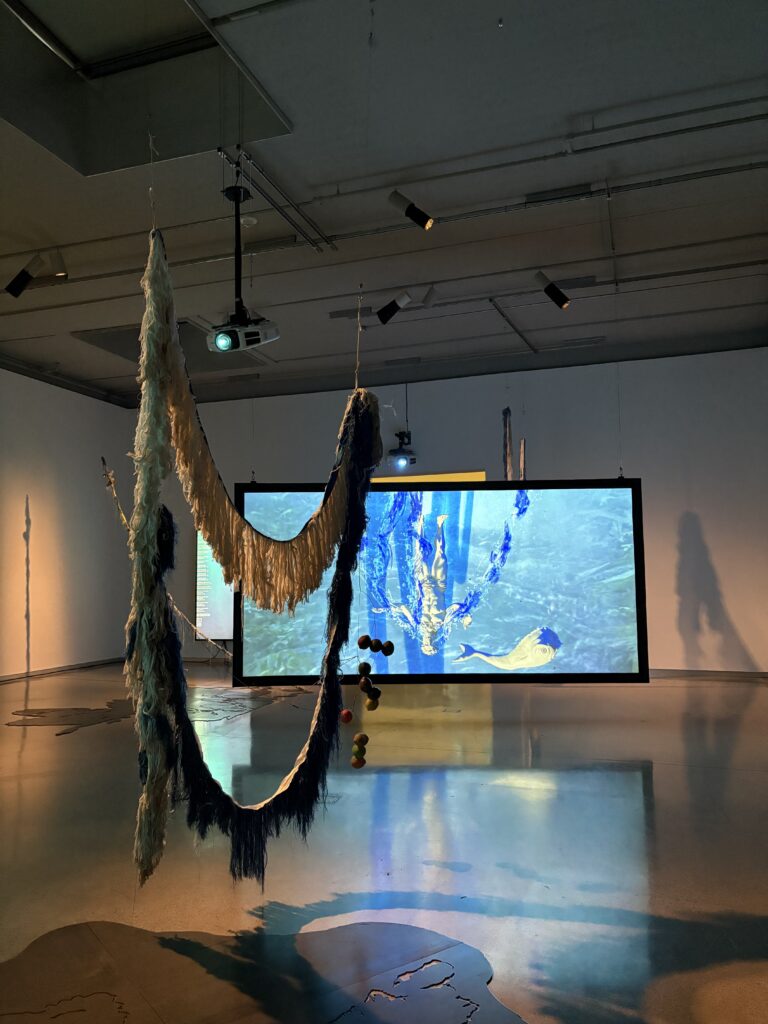
To only see this work through the lens of these personal feelings, however, would be doing Creuzet a disservice. The exhibit is also concerned with broader histories and communal experiences, and these marred aquatic fantasies exist precisely because of history and culture. As the exhibit’s introductory signage explains, Creuzet, a French-Caribbean artist, crafts a “hybrid world shaped by collisions of colonial powers and the cultures they absorb,” with water being both “a site of historical and contemporary aggressions and traumas” and “of emancipatory futures.” The interplay between these underwater scenes and Creuzet’s concern for liberation from colonialism’s legacy feels most clear to me, in retrospect, in a video of an upside-down statue of a figure, emblematic of classical Greek or Roman art, jerked around by tendrils of water. The sculpture never frees itself or returns to an upright position. Waters that were once a backdrop for oppression seem to be fighting back. Meanwhile, the lyrics of the exhibit’s musical accompaniment assert: “Our gods live / Our states,” helping to frame all of Creuzet’s work through this celebration of a vibrant and resilient Caribbean identity.
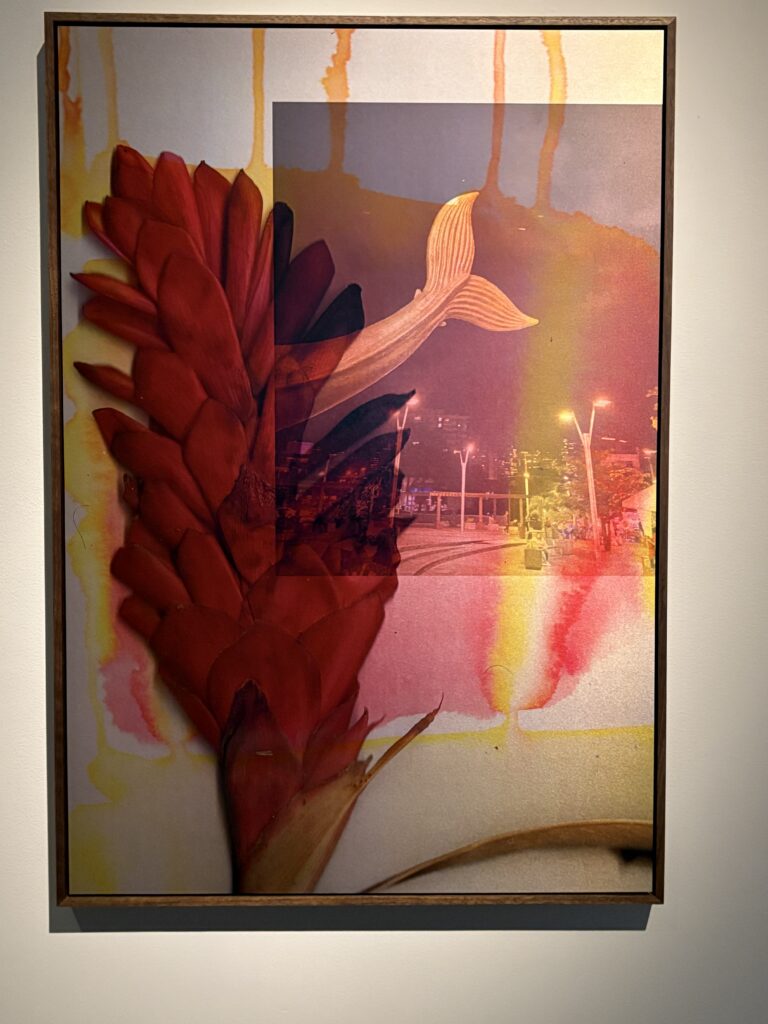
After a slow walk through Creuzet’s sensorial feast, the exhibit culminates at the back of the gallery space where yet another art form is introduced. Dye sublimation prints, saturated and colorful, incorporate a greater degree of realism than the rest of the exhibit. One piece captures the mottled texture of leaves, while another overlays a man, in profile, with the texture and color of a palm frond. Another print incorporates both an image of streetlights and a tail of a whale. After asking us to look at unknown worlds, Creuzet reminds us of the real places and people that likely inspire—the places and people presumably in relation to the waters he reimagines—before turning once more to the surreal.
Across from the dye sublimation prints is a screen the length of the wall, much larger than any previous video installation. Statues, reminding me of the drowned statue earlier in the exhibit, are above-ground this time. They dance atop a fountain, green grass behind it, while water and fruit continuously whirl around them. Stormy clouds shift, ominous in the background, the sky a dusky orange.
During my first visit, I find myself surprised by emotion watching this final video. I can’t name why I am so stirred by it, but in the moment I don’t need to—knowing it is as valuable to encounter and commune as it is to understand. Perhaps I already know I need to return. During my second visit, I wonder why I find this final video, and the videos in general, so striking. I suspect the sensuality—how the moving bodies, swelling sounds of water, and shifting hues of sky seem to intentionally overwhelm. Then I think about Hieronymus Bosch, the Dutch painter of the fifteenth and sixteenth centuries known for his vivid depictions of heaven and hell. I have loved Bosch’s work for years, in part because encountering Bosch is to encounter a powerful imagination—even if, at times, an imagination that disturbs. Experiencing the work of Creuzet feels like encountering another lively imagination throbbing with spiritual significance. For Creuzet, like Bosch before him, spiritual art is not a saccharine affair but instead demands rigorous creativity and a largeness of vision. The music backing the exhibit attests to Creuzet’s spiritual aims: “From feet to fresh head / Water blessing. . .This water will give you strength . . . / This water is rejuvenation . . . / This water is liberation . . .”
Though on a purely visual level Creuzet’s work rewards a single visit, two visits convince me that the dialogues between the exhibit’s works are richest through slow and inquisitive gazes. I suspect I’d have uncovered even more with subsequent returns and feel, even now, that there is more to gain from letting my thoughts linger on my impressions longer than my eyes got to linger on the details. Creuzet’s creations deserve to be brought into conversation with each viewer’s personal touchstones—spiritually, artistically, literarily—for considering blessing, liberation, resistance, and even the nature of existence itself.