I.  Show-and-Tell

In kindergarten, I participated in show-and-tell only once. “I am going to show you stars,” I told my classmates. The class looked at me, waiting for stars. I lifted up my dress all the way to my neck, held the fabric in place with my chin, and used both hands to point nippleward. “Look at the stars!”


II.  Introduction to Acting

I started taking Robert’s acting classes when I was 13 and he was approaching 30. He was an open, agile, and spritely actor who made eye contact that made me keel over. The class met in the basement of a Philadelphia church where I’d heard Kevin Bacon’s family went.

Robert asked us to warm up by walking around the basement as if we were moving through peanut butter. He demonstrated, his full body engaged, controlled. The peanut butter was thick; Robert was lithe. I traced his veins, visible under his skin, as he stretched his arms. Moving slowly, I looked at my own arms for what felt like the first time and tried to make a muscle that I could see. Then: chest isolations. I jutted out my chest. The rest of me couldn’t stay still. I wished the other six days of the week would vanish.

Early on, I worked on a one-act play that proved challenging, given my lack of real-life experience. While the character I played was lonely and naive, I couldn’t fathom her sadness. Nor could I fathom the kiss, mid play. Though Robert talked about character, I could only see what acting in this play would mean for me: Robert was enabling my first kiss. Choreographed. Pretend, but made real by Robert. Robert watched me and my classmate, Tim, rehearse. Tim was a pale, freckled eighth grader like me. He was also my neighbor and a longtime crush. When it came time for the kiss—the closed-mouth kiss—Tim and I stood feet apart, unmoving. Robert saw the awkwardness and stepped into Tim’s role.

Robert said: Make eye contact, unfold your arms, and move slowly toward each other, your bodies open. See each other. Then lean in and hold for a beat. Then he said: I’ll show you.

Robert looked at me. I looked back. He had a wiry but solid body. He wasn’t so tall, but his penetrating stare and open stance made him big. He stood a couple feet away, sweat glistening on his face. Beat. He approached, still looking. Beat. I tried to mirror him. Beat. His mouth slightly opened. Lips above my eyes, though there was time for aiming. I stood tall. Beat. Lips touched my forehead. Beat. I felt disappointed, and I felt the kiss with my whole body. Could he see that? Beat. He stepped away, but held my eyes while telling Tim to come back. I can still see: Robert’s arms outstretched, eyes that wouldn’t blink, hands and the rest of him open, seeing me.

My friend Alex indulged in teacher adulation with me. We made an enlarged photocopy of Robert’s headshot from a play program, cut out the head, and attached it to a little construction paper body. We paraded our paper doll teacher around Alex’s bedroom and took pictures of each other holding him close. We sent that doll in the mail to him with an attached note: “saying hello.” We dared ourselves to add “sending love” and our names, and then we did. He acknowledged receiving it with a brief “thanks for the photo.”

I took his Saturday class for a few years, but never auditioned for theater productions at my high school. I preferred peanut butter walks, character exercises, and scene study with Robert. At sixteen, I decided to take myself seriously, which meant applying to a summer theater program. I needed a recommendation. Robert had never praised my chest isolations, but he had given me specific compliments about choices I made when rehearsing and performing scenes. He took me seriously. I asked him to write it, hoping he’d forgotten about the creepy paper doll gift from years earlier. He gave me the letter in an envelope with his signature across the seal. What he thought of me was in my hands. I practiced his signature and procured a new envelope. Then I unsealed the letter. “Her vulnerability is her greatest strength,” he had written.

Deflated and confused, I interpreted and reinterpreted, based on what he could have said but didn’t. He didn’t say I was talented, excellent, or a rising star. He didn’t say that I worked hard. I knew I was vulnerable: to sunlight, criticism, the smallest of feelings of others around me. It was something else though. I unfolded my arms and put myself into characters, relationships. I performed material far from my life and made it mine, made characters me. I didn’t look away from him when he came toward me for a kiss. I was open and ready. I wasn’t sure exactly what he meant, but it felt like being known and even like being touched.


III.  Introduction to Filmmaking

Assignment: An ad for an idea, no more than one minute long. The idea is up to you.
You’re supposed to brainstorm, but do you really? The idea comes to you like a cartoon lightbulb while you’re eating fries with your best friend: You will make a black and white film of your vagina. Black and white, so no one will recognize the orange pubic hair.

Audience. This movie starring your vagina will be screened in class and later at the campus cinema where everyone will see it. Everyone includes your cultural studies professor. She’s in her early thirties, freshly dissertated and doctored, a sharp hire across multiple humanities departments. She’s smart without the tweedy, bearded intimidation, and she loves lenses— Marxist, postcolonial, feminist, queer. Her focus on sexuality, even in dense writing, draws you in. She could be the answer to some of your questions about desire and fulfillment. She discusses and complicates the notion of desire in class, albeit from a distanced theoretical standpoint. You feel sexy when you feel complicated. You take all of the classes that she teaches. You force yourself to approach Cagney and Lacey from a female-empowerment-during-crisis perspective and spend hours doing a shot-by-shot analysis of Supermarket Sweeps.

Pre-Production: A Finnish exchange student wakes you up in the middle of the night to ask you about phallocentrism in a Buñuel film before he fucks your roommate. Later that night, he tells her that sex is a revolutionary act. Feel inspired. The opening shot of your film will be a slow-motion zoom, outside to almost inside, drawing the audience in. The film will further cultivate your academic crush.

Image: Get your best friend to film your vagina by paying for his breakfast at the diner on a cold October morning. You tell him you will need a lot of vodka to go through with it, but you end up doing it stone cold sober. You are uninhibited in that way; alcohol would give you an acceptable reason, but it’s not yours. Show him how to work a Bolex. You are propped up on a pillow for angle’s sake. Your friend is into photography. He focuses on camera technique, providing a barrier between you and him that you didn’t know you needed. You pretend you’re at the OB-GYN for a check-up, with less invasive work and more control over the proceedings. It will be over soon. Just breathe and relax. It helps not to see his face. You stay still. He moves the camera silently as you direct. “Zoom in. Now out.” This giving instructions thing is new to you. Think of the men you never prompted, but might have. It’s not a turn-on at the moment, but it’s practice for the future. “Now move the Bolex slowly clockwise and back.” You watch the camera moving, watching. “Pull focus. Make me blurry,” all on grainy black and white 16-millimeter film. After he’s done, he asks, “So what is this movie about?” You don’t know, except that it’s important. You want to see yourself and you want to be seen. You have read John Berger’s Ways of Seeing and Laura Mulvey’s “Visual Pleasures and Narrative Cinema.” The male gaze occupies your brain space. You’ve had trouble intellectualizing your desires, or maybe the issue is that you’ve had no trouble intellectualizing your desires. “The assignment is an ad for an idea,” you say. “I have no idea. I’ll show it to some people. Maybe they’ll know what the idea is.” Now hedge.

Sound: You will have men and women’s voices in the background, talking about what
they see when they look at the images. You show a few friends the raw footage, and record their reactions. They only say, “I think it’s a vagina. Yes, a vagina. A vagina, really close up.”

“Will people be able to tell it’s mine?” you ask, unsure if you want them to say yes or no.

“Redheads have a way of looking redheaded, even in black and white,” says your friend who filmed it. The others nod, having no idea.

Analysis: The film will be called Criterion. Your filmmaking professor keeps asking the class, “What are the stakes?” You are scared of people seeing or recognizing you. You also wish they would. Worry that your film does not have stakes for feminism or visibility outside of yourself. Is it possible that you just wanted to be on the big screen?

Graphic Editing: Notice a sculpture on campus that looks familiar somehow. The sculpture has concentric stone spheres. It is called, “Fertility.” Film the sculpture, using the same camera movements that you’d instructed your friend to use. You will juxtapose the sculpture and vagina images, splicing them together, here and there.

Critique: Email your filmmaking professor to give a heads up that the film you’ll be showing in class contains a few extreme close-ups of a vagina. She is a lesbian filmmaker. You almost don’t want to tell her because then she’ll think that you think it’s a big deal. Though you are starting to think it just might be a big deal. Write: “It’s not a big deal. It’s not that kind of vagina movie.” She responds, “no problem.”

Arrive to class early to set up the reel in the projector. The room barely fits a seminar table that is really four smaller tables. Ten seats take up the space between table and wall. The screen is the size of a pull-down map in a high school classroom, except in this tight, windowless space in the theater department basement,  it takes up an entire wall. In order to avoid watching it yourself, you spend a long thirty seconds behind the projector, focusing on the back of your classmates’ heads.

The professor flips the lights and pulls out a chair at the table. She prompts you to explain your work to your classmates. Take a deep breath. Look directly across the table at one of your classmates. It’s the guy you went almost-skinny dipping with.  He never talked to you again. Your only memento of your night together is a pair of lint-covered underwear you wish you’d taken off that night. He is looking at one of his palms like it will reveal treasure with just the right glance. The usually talkative group is silent.

Say some things from an internalized word bank of theory: object, subaltern, mechanical age of reproduction. You remember Barthes’s “Death of the Author” essay and become excited that your intent, lacking as it is, is irrelevant. You tell them the meaning is in their. . .  hands.

“Any suggestions?” you ask. “Maybe you could add a penis?”  a cheerful guy from Milwaukee offers. “Another sculpture for texture?” an art history major suggests.

Focus: Senior year is almost over and you will have to get a job. Your new boyfriend tells you that all you have to do is decide if you want to be a doctor, lawyer, or psychologist and then just do that. He’ll find out about your movie when he goes to the screening.

Festival Screening: You wear a satin dress that you bought at the mall. The festival screening feels legit. It is held in a real cinema on campus, one with over 200 seats that fold up when you stand. You laugh ruefully, remembering the map-sized screen in class. When you saw Pulp Fiction here some months back, you hadn’t concerned yourself with the size of John Travolta’s face. Now it’s much, much larger than life. Your movie comes after Babe-o-wulf, an overexposed frat boy’s exploration of the epic poem Beowulf, and Die Shadow Motherfucker, a battle between a man and his shadow to the tune of the Mortal Kombat soundtrack. These films are crowd-pleasers. If your class screening were any indication, people won’t know what to do with your project. When it starts, you don’t know, either. It’s so. . . big. You feel swallowed up by it, like that story you read about Picasso getting aroused by his own drawing while everyone else was just disturbed. You are sitting in the front row with the other members of the class. You wonder if you are overdressed. Your grainy vagina casts light and shadow on you, the faces of classmates, and friends and strangers sitting behind you. The boyfriend is in the back with his friends, a six-pack, and a dozen peach-colored roses.

Reviews: Your film theory professor waits by the exit, greeting students. She sees you and flashes a grin that you willfully interpret as “You’ve got spunk! What are you doing later?” Then she says, “Hey, that was quality work. You troubled some boundaries in a beautiful way.” She holds out her right hand; her left one is with someone you don’t know. You shake her right hand, and then, unable to help it, you curtsy. People are rushing to leave the theater, so you pull yourself together, smile, and move on. As you walk toward the door, she congratulates another student: “Hey, that was quality work. You really troubled some boundaries.”

Sequel: The boyfriend waits outside with his friends, each with their own Corona. They are speculating about the identity of the woman behind the vagina. They eliminate several based on the mere existence of pubic hair. To his credit, the boyfriend has not contributed to the fact-finding mission, at least not since you showed up. He is waiting with roses, a leftover Corona, and a smile. He takes your hand, and you head for the arts quad. You wait for him to say something. He says, “I couldn’t look away.” Then leans in and whispers, “Who’d you get to be in  it?” He couldn’t tell it was you. Take his Corona and stick your tongue down its throat. Take his hand and walk him through the quad. Pull him down to the ground behind “Fertility.” Pull down your underwear.
           “Look!”

Blackbird
An online journal of literature and the arts
close
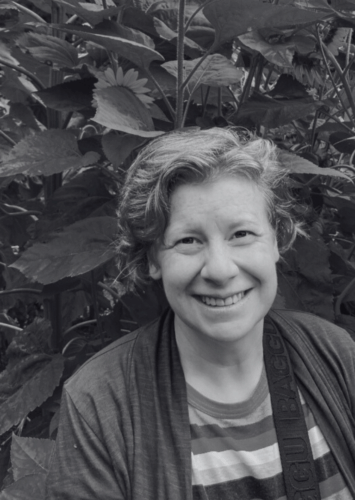
Kasumi Parker
Kasumi Parker’s essays have appeared in Black Warrior Review, PRISM international, Porcupine Literary, and elsewhere. Her writing has been supported by a residency at Vermont Studio Center. Kasumi is an English teacher in New York City.
Footer
Sign up for our Mailing List
Support Blackbird
Founded in 2001 as a joint venture of the Virginia Commonwealth University Department of English and New Virginia Review, Inc.
ISSN 1540-3068

Virginia commonwealth university
Blackbird
VCU Department of English
PO Box 842005
Richmond, VA 23284-2005
Virginia Commonwealth University is a nationally renowned public research institution dedicated to the success and well-being of all members of its community. VCU student, faculty and staff groups and associations are open without regard to any characteristic or identity protected by law.