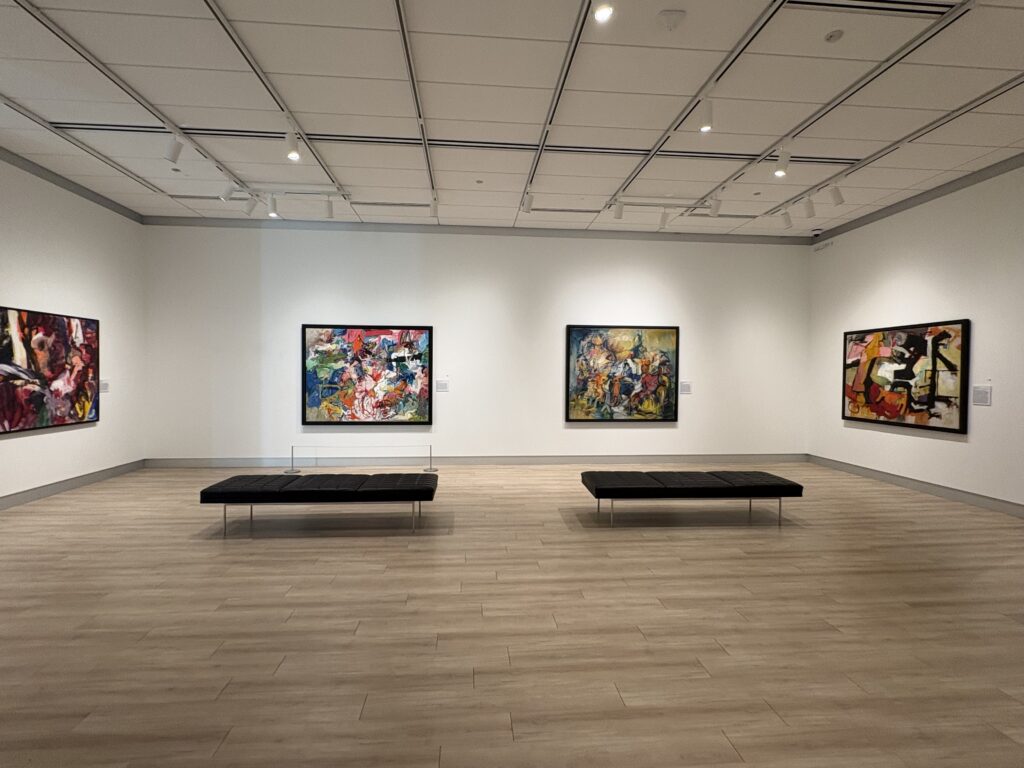
Abstract Expressionists: The Women was on view at Muscarelle Museum of Art at William & Mary through April 26, 2026. A touring exhibition organized by the American Federation of Arts from the Christian Levett Collection and FAMM (Female Artists of the Mougins Museum), France, it will continue on to the Speed Art Museum, Grinnell College Museum of Art, Mobile Museum of Art, and Frick Pittsburgh Museums and Gardens.

The soft swirliness of Miriam Schapiro’s Idyl II leads me to thinking about her abstraction as invitational, as fantasy. The placard next to her painting quotes Schapiro talking about the process of finding a “possible personal iconography” in art—a phrase that has remained with me while mulling over my experience of the epoch-illuminating exhibit Abstract Expressionists: The Women. What did the brushstrokes, shapes, and colors mean to the women behind them who painted these works between the years 1936 and 1977? How does a viewer, with their own idiosyncratic visual associations, interpret the “personal iconography” of these artists? Perhaps it’s my own inner “personal iconography” that shines a spotlight on certain pieces over others.

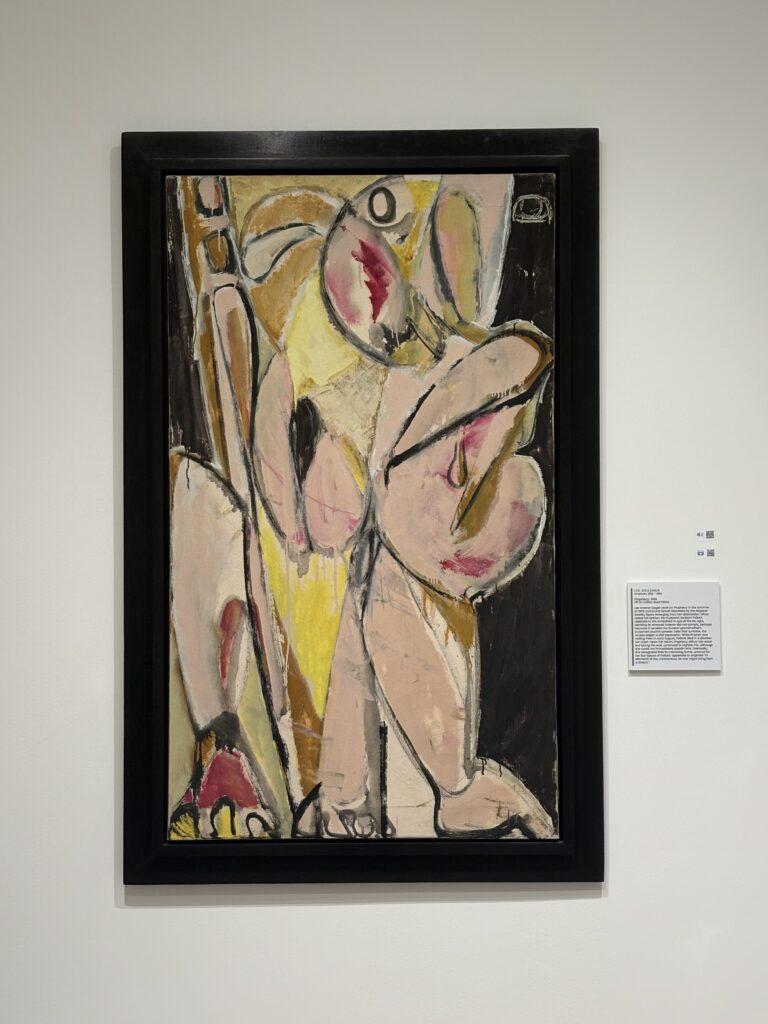
Take, for instance, Lee Krasner’s Prophecy (1956). The yellow, pink, and cream-colored hues suggest softness, while bold black outlines and indelicate shapes might call to mind strength or chaos. Krasner’s sense of the painting was different from my own, however. The accompanying description alerts the viewer that she was frightened by it. Perhaps to combat its frightening aura, her husband, fellow artist Jackson Pollock, apparently recommended that she remove an eye in the upper-right of the painting, but Krasner kept it—and kept at this painting, despite or maybe because of what it evoked in her.
I was drawn in, too, by Sonia Gechtoff’s The Map (1958). The contrast between the bold colors at the painting’s center and its use of black and white made me feel like I was being drawn into the heart of something—something alive, mystical. It was not surprising to read, then, that Gechtoff had a “‘sensuous, almost hedonistic affection’ for paint.”
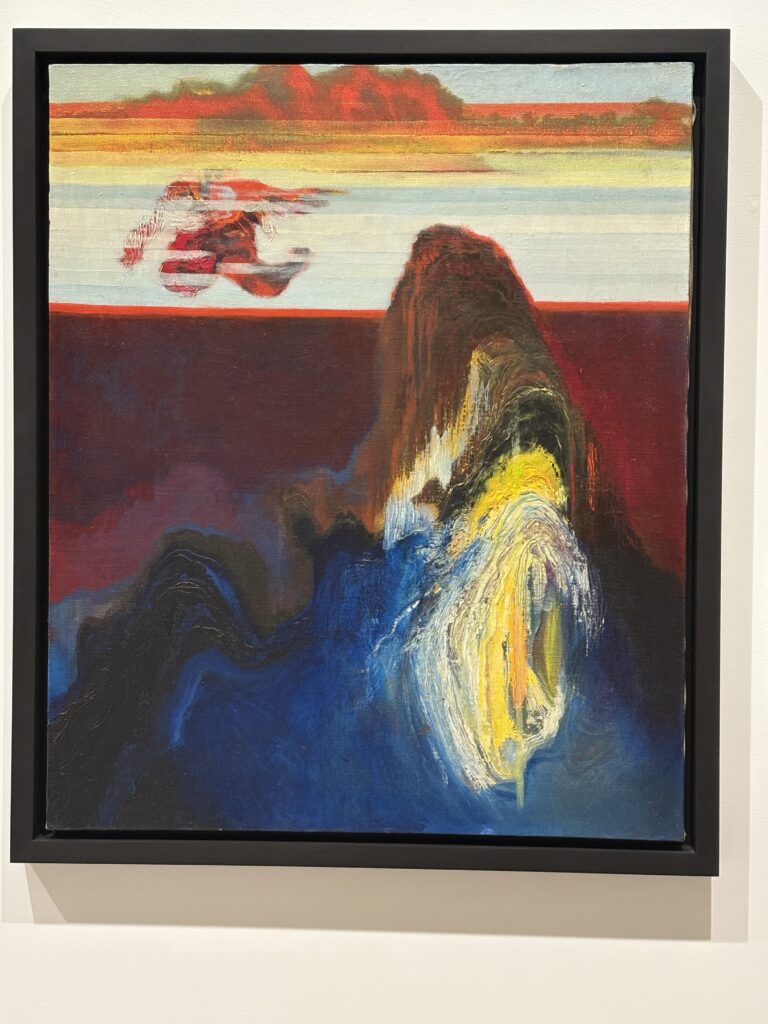
I was captivated, too, by the rich colors of Lily Fenichel’s Ochre, Red, and Blue (1950), which felt substantial, immersive, like a worn-in kind of love. Pat Passloff’s Stove (1959) engaged me with its gentle blues and vibrant, pulpy orange, its layers calling to mind hiddenness and emergence as a lone, mysterious reddish-brown X looms in the upper-right corner. Bernice Bing’s Big Sur (1967) gifted me something of its inspiring landscape more viscerally than many more realistic paintings might. As someone interested in feminist theology and religious poetry, Ethel Schwabacher’s Woman: Red Sea, Dead Sea (1951) felt like an invitation to ekphrastic writing that was made just for me. I found myself wanting to wrestle with the relationship between the title’s allusions, both to biblical narrative and gender, and the image itself: a tide of bloody reds that overwhelm the canvas, yet somehow also leave space for verdant greens to peek through in the background.
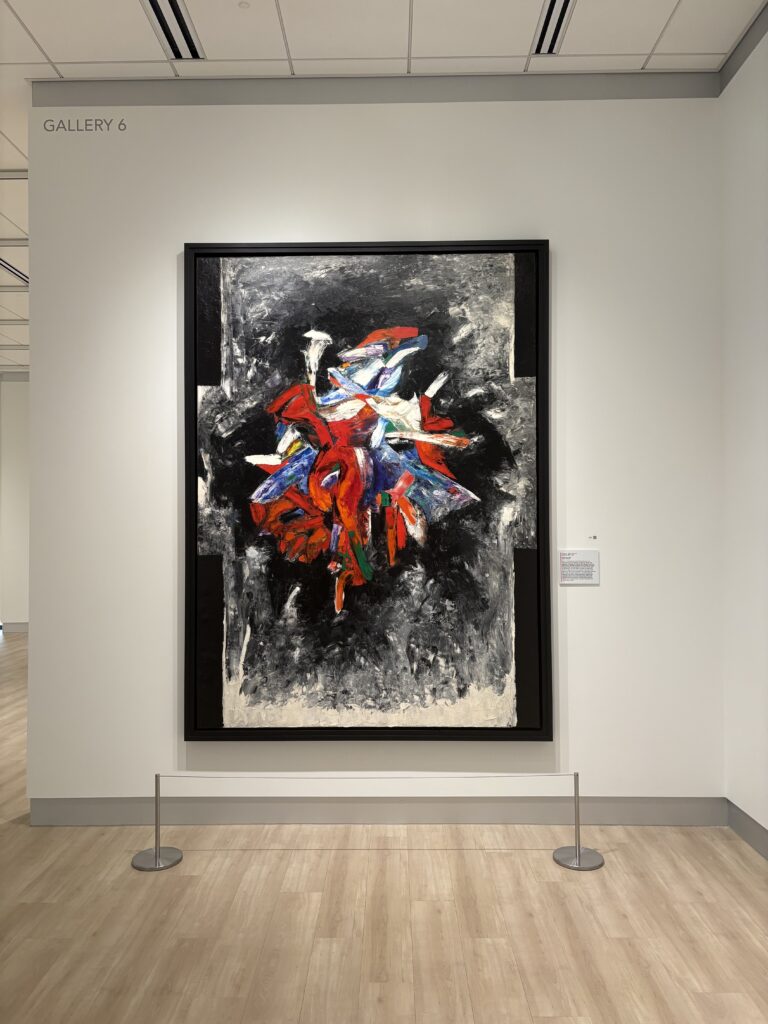
My love for these paintings doesn’t make it any easier to pinpoint why they moved me while other instances of abstraction do not. My experience as a viewer feels connected to featured artist (and well-known figure in this movement) Joan Mitchell’s comparison of her work to being “more like a poem” than narrative writing and to Mary Abbot’s saying of her art, “defining the poetry of living space, that is my aim, life, and work.” As a poet and student of poetry, this association feels truthful, even if it’s generalizing the genres a bit. Sometimes, abstract expressionist paintings can feel perplexing, or like nothing is really happening, but when they work, they work. These artists risk confusion, nonchalance, or someone’s grumbling, “Well, I can do that,” in order to enter the powerful space of non-definition—where personal iconographies of artist and viewer can speak to each other. Similarly, poetry must sometimes risk misunderstanding for the sake of opening things up in a reader that overt messaging cannot always reach.
Although the non-narrative work of these paintings is core to the exhibit, attendees should also allow themselves to be enriched by this exhibit’s stories, provided in the painting’s accompanying texts. Through Abstract Expressionists: The Women, you may encounter work by artists you know (I was excited to see Lee Krasner, Janet Sobel, and Helen Frankenthaler in particular) but likely also artists you’ve never heard of or who you don’t associate with abstraction. One section of the exhibit is labeled “Vocal Girls,” a term some of these artists earned in the press for not keeping intact the separation of art and artist in the same ways as their male counterparts. The exhibit takes this vocality to heart—allowing the artists’ perspective to contribute to, though not dictate, the viewer experience. We might consider the whole exhibition, for instance, in light of the words of artist Sonja Sekula, “I shall begin to speak of the New, a new time, a future that we begin to feel underneath the current of war and strife and uncertainty.” We may feel how this same impulse can speak to and stir new art in us, in the midst of the war, strife, and uncertainty of our own times.