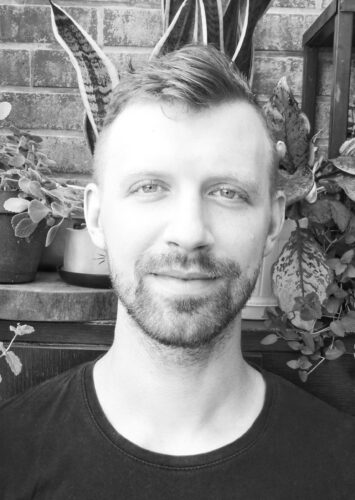
Matt Schroeder
My name is Matt Schroeder. I was Blackbird’s Managing Editor for the 2024-25 academic school year. I’m here with Megan Pinto to discuss editing.
Megan Pinto
I’m Megan Pinto. My debut collection, Saints of Little Faith, came out with Four Way Books in 2024, and I just released a UK edition with the87Press in late 2025. I live in Brooklyn.
MS
I always think a good place to start with conversations like this is to make sure that we’re thinking of the topic that we’re covering on an even ground. So what does editing mean for you?
MP
When I think about the word editing, my brain immediately goes to revising, which, to me, has to do with listening, becoming aware of what the text wants to be versus what I think it should be. It’s a process of attunement. I think about revision in terms of music. There are the sonic elements and semantic elements (the argument). There’s also a level of editing that happens while you’re ordering a sequence of poems or a book.
MS
Yeah, I also think about it as part of the writing process, not as a secondary act. And I’m glad to hear that you’re also thinking about things like sound. I think a lot about sonics and the engine of the poem, and of what the primary goal is, what’s moving the poem. When I’m drafting, I have to make a very conscious effort not to allow the editing to happen.
But just like you mentioned, I’m always thinking about the additional poems surrounding a piece. That may be more that I’m coming out of having just put a book together. A lot of the editing that I’ve been doing this year has been thinking about pieces in conjunction with one another. The other thing that I think a lot about is critical distance. Sometimes I need to just step away for a day or two, or a longer stretch to really get that distance, to look at it with a more neutral eye.
MP
I agree, yeah.
MS
Lately I’ve been thinking a lot about the process and how editing is something that we aren’t taught how to do, even if you go through a formal program like an MFA. A lot of times you go to workshop, you sort of synthesize on the fly, you get everybody’s notes, and then you go back to that private place where you’re doing the writing, and it’s on you to do the editing. And so, while editing itself is one of the ways that we develop those editorial muscles, how have you learned to edit and refine your editing process outside of the workshop model?
MP
That’s a great question. When I went through my MFA, I didn’t have a formal workshop model because I did a low residency. During my thesis semester, I worked with the poet Dana Levin, who reminded me of what Ted Hughes wrote in the introduction to The Collected Poems: Sylvia Plath. He said something like, if she couldn’t get a table out of it, she would be happy with a chair. That quote makes me ask myself: What is possible with the language on the page? And then also, what am I capable of in this moment?
This goes back to what you were saying with that critical distance. I have to stop hearing the music of the poem as it’s written in my head. And sometimes that takes a couple of days. Sometimes it takes a couple of months, but when I stop thinking about it and hearing it, then I’m actually ready to go back with not only fresh eyes, but also fresh ears. And that’s what helps me pick up on any dissonance.
But I’ll also say, going back to this question of “how do you learn these skills,” a huge part of learning to edit or revise is really about structure. In any piece, poem or prose, what’s the order of information, and how am I telling it? And is this order creating the desired effect? Or is it actually just confusing? In thinking about structure, a way to practice revision is to rearrange the parts of the poem. Let’s say you write the draft one way, and then you flip it upside down so your ending becomes your beginning. What questions does that bring up in the poem, and what gaps do you have to write into to fill that? Revision is also generative.
I think too, as we’re speaking about the music of the poem, that I sometimes need silence or to forget the music entirely. Sometimes, the syntax is the placeholder, and what I need to let go of are the actual words. The meaning that actually needs to come in is totally different than what I’ve written. That happens to me a lot, and I can only work through it by giving myself the space and time to detach from the first draft. There’s a great craft book, Structure & Surprise: Engaging Poetic Turns edited by Michael Theune, that I would recommend for anyone curious about revising. I read it during my first semester of grad school and it’s still on my shelf. It’s a companion I love to return to. I think it’s a great introduction to structure.
What have you found in terms of developing your own editing skills?
MS
First off, I love what you said about syntax as a placeholder.
I think so often about the comparison between poetry and music, and so I hear what you’re saying there. Sometimes the pattern is there, but it’s figuring out what notes to use to achieve the desired effect. Insofar as how I’ve developed my editing skills, it comes down to tinkering. One thing that I like to do is erase all of the line breaks, put the poem into a block, and then relineate. As I enjamb, it tends to blow the form up a bit. It’s an interesting way to try different containers to see what will happen.
I also like the point you made about asking what else can be explored structurally, because it opens up a lot of generative avenues that can be explored, which might result in individual poems or a sequence. Or maybe one resulting poem better enacts things that another two poems are doing. So you can just slide two out and slide the one in. But I’m very much a doer. I have to get in and continually work little by little.
And so there are two primary categories that folks tend to fall in when we talk about editing or revising. Yusef Komunyakaa, who is a chiseler, advocates for getting a generous draft out and then revising down. But I’ve worked with professors who are big advocates for continuing to expand drafts. So I’m curious as to where you fall on that line?
MP
That’s such a good question, because I find that I tend to read very widely. I love a very short lyric poem, but then I’ve also spent a lot of time with Larry Levis’s collected, Swirl & Vortex, which just came out. I took a workshop with Martha Rhodes right after grad school, and she talked about this image of the accordion and how, when you revise, you’re learning to play the accordion, you’re compressing and you’re expanding. Having teachers or texts on either end of the compression / expansion binary is so helpful, because it kind of forces you to experience those two poles. And I do think you have to learn how to work both extremes. The question then becomes “what does this particular poem and project call for?” Maybe you do need a lyric with a lightness of touch and a lot of white space on the page, or maybe you need more of a discursive argument with narrative that is being moved through time, or even just more prosaic lines. Sometimes a way to discern what the poem needs is by investigating the sound and feel of those initial lines and images.
Sometimes, it’s nice to go in that natural direction. But, in the spirit of revision and experimentation, I think it’s good to try the opposite, because sometimes, if you force yourself to take a sprawling draft and condense it down, you might learn you actually don’t need it, or you might just discover a beautiful phrase or image that maybe begins or ends the poem. You just never know, and I think that’s the point.
When you’re playing this accordion of your work, just be open to what comes up and really practice moving between those modes.
MS
That’s where so much of the fun is as well. I don’t know about you, but there’s a magic in generating where I finish a draft and am overcome with awe. But I also feel that in the editing. To be able to capture that magic, whether it’s expanding or condensing, really scratches an itch for me.
MP
Yeah, I agree. It’s in the discovery. I love feeling like something new is happening in front of me as I write. That’s a beautiful feeling.
MS
Yeah, for a long time, I leaned much more towards chiseling away. But the more that I practice and explore what’s possible, I think, just like you mentioned, about texture, about when do we need a breath of air versus drilling into something? I think that’s really pushed me more into the expansion realm.
But I always try to do very big first drafts anyway. So with expansion too, a lot of times I’m thinking about additional poems, whether that’s a cycle, or just poems that live in the same universe.
MP
I love what you said about breathing room, and I think that’s where what you mentioned earlier about putting something back into a prose block, and then finding the line endings again and again is so valuable. Inevitably, if you explore stanzas as well, you’re finding different places. And I think that’s such an important part of revision too. Not just the bigger structural pieces, but each line as a unit of meaning, each stanza as a unit of meaning, and the pacing between all of that. And so even if you have a draft that looks prosaic at the beginning, you could then have a poem that’s super long and thin on the page. And what does that do? What is the effect of that pacing?
MS
Yes! And I mean, even if we’re talking about a long, skinny poem, the poem has room for expansion and compression, it may just not look like what we might imagine when we initially think about compression and expansion.
One thing that I always love to ask about, in terms of editing and revising, since you’ve been at this a number of years, is how is your process different now than it was five years ago?
MP
That’s a great question. Five years ago I would have been deep in my first book. I think what’s changed is that I have a lot more faith in leaving things unresolved.
It’s still hard. I still want to finish things, but now it just doesn’t do it for me. There’s a greater part of me that’s like, no, this draft is not done. I can’t just, like, move this into the done pile or whatever.
So, I think my faith in the process has grown. I think that about five years ago was actually when I took a workshop with Myung Mi Kim, and she had some great advice that has changed my writing life. I believe she said she would use butcher paper, printing out all of the drafts and taping them up and just living with them. That’s been a huge game changer for me, because what happens with that is my eye can casually visit the work. It’s not just during drafting. And a lot comes from those visitations.
So that’s one thing. I live with them on the wall for a while.
Another thing that she counseled was taking the draft on a walk. And so sometimes, if I’m stuck, I’ll just literally take the draft on my walk and I’ll kind of look at it, and I’ll walk, or I’ll sit in the park, you know, just moving, getting outside, letting the act of writing become embodied, because our lives are embodied.
If I’m stuck, I also love to lay down for 10 minutes or meditate. And I think it’s that dream state, the in-between state where sometimes ideas will come. Doing the dishes works, too.
So, I guess what’s changed or grown in my revision process now, is that I try to create more liminal spaces for me and the work. I also love the subway for that. I love taking my poem on the subway or just reading a book on the subway. I find I get so many more ideas, and I’m so much more responsive to what I’m reading, even if I can’t read, in some ways, as deeply or for as long of a duration. It’s reading for a different purpose.
Really, what’s changed is that I’m more playful, and I try to catch my consciousness off guard.
And then for drafting, I found I really like writing first thing in the morning, even if it’s just for five minutes. But I really find pre-screen, pre-verbal writing time, if I can get to it, if I don’t just have to wake up and go, is wonderful, because it’s so strange what comes out. That also makes me want to revise, because I’m like, What is this? But also cool. Thank you, interior!
MS
Absolutely! I’m also pro-first-thing-in-the-morning. And I love what you said about taking a poem out for a walk. It’s so important to write in the same place, because if I get stuck, everywhere else is taking it out for a walk. You know what I mean?
Another thing I’ve been thinking a lot about recently is just letting my subconscious do the work as well. I think that a big part of taking a poem out for a walk is that if we get stuck, the interior self is still in there doing the work, taking time with the poem, sorting itself out.
I also find that, because I’m so close to a lot of my work, and especially this year, as I’ve been working on my first book, it’s so much easier to look at other people’s work and to edit outwardly.
Could you talk a little bit about your relationship to editing other people’s work versus your own?
MP
Yeah, I agree it’s much easier when it’s not my own work, because I’m not as attached to the first intention. When I edit other people’s work, I’m able to point to multiplicities within the poem. So, going back to the binary of concise lyric versus sprawling, sometimes in an early draft, I’m able to note how the poem could go either way. With other people’s work, I’m learning to see a vast array of possibilities, and that I don’t have to force one solution. And I feel a sense of faith, especially for my friends, when I’m reading their work, of like, oh, you’re absolutely going to figure this out. I can be so hard on myself when I’m facing a creative problem, but I don’t feel that way with my friends. I think revising other people’s work is inspiring. It helps me in my own revision process, because I am thinking through the same elements. It’s like a way of practicing, and it helps me remain open minded when I finally do go back to my own work.
MS
So, in thinking about the multiplicities that exist as you go back to your own work, we inevitably end up working on individual poems that we would love to be able to stand alone, but we also want to put collections together, whereas we hear these poems sort of coalescing towards a thematic universe, we inevitably get into editing towards something more than an individual poem.
How does editing when thinking horizontally, when you have all of the poems up with the butcher’s tape, look different for you than working on an individual poem?
MP
Well, when I’m working on an individual poem, I’m editing each poem to stand alone because when I’m publishing them they will be encountered alone.
In terms of revising individual poems into a book, I suggest assembling a chapbook. Chapbook competitions helped me learn how to order my poems, because they forced me to pull together my best twenty to twenty-five pages of poetry, which is very instructive. Sometimes I realized I only really feel good about these twenty poems. And actually, even though I have other poems, I don’t like them. Or I would learn that none of my poems were talking to each other, which meant there were gaps in the project I needed to write into. And then, you know, in grad school, going back to “how do we learn to revise?”
Grad school was so helpful for learning to write a poem and thinking about the individual poem, which is so hard, you know? There’s a lot of work that goes into that, but I do think writing a book is another level of learning. I spent a lot of time with Voyage of the Sable Venus and Other Poems by Robin Coste Lewis and Life on Mars by Tracy K. Smith, and I studied how these books organized their sections. From ordering my poems for chapbook competitions, I knew that my book needed sections. Both of these books moved between the elegiac and erotic modes. I studied how Section A spoke to Section B and so on. It was a generative time, because then I started to see new possibilities for how my own poems could speak to each other.
The last thing I’ll say is that, even after my manuscript got accepted, I kept writing poems towards that book. And I was able to replace a few poems with newer ones that better spoke to the book’s concerns. Just to keep writing while you’re submitting, even once you think the book is done, just exhaust that mode. And then there will be a moment where all of a sudden the poems you’re writing don’t belong to that project anymore. I think the process organically works itself out. Even once the book is accepted, keep writing.