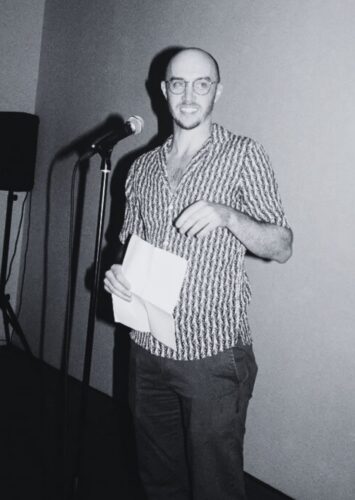
Grace Spulak’s story The Four Winds, from her debut collection Magdalena is Brighter Than You Think, was published in flight 24v2. Fiction editor Sam Schieren spoke with her via zoom about her new story collection.
Sam Schieren
Thanks for taking the time to chat. I know it’s pretty early in New Mexico.
Grace Spulak
I’m actually in Siena, Italy, so it’s afternoon here.
Sam Schieren
Ah, well then that’s perfect. What brings you to Italy?
Grace Spulak
I’m doing research for a novel.
Sam Schieren
Do you mind if I ask about the novel?
Grace Spulak
Sure. It’s inspired by a 14th century mystic, Catherine of Siena.
Sam Schieren
An Italian Catholic mystic. How’d you wind up studying her? It seems far afield from New Mexico.
Grace Spulak
My interest in gender and how social structures around gender play out over centuries. Also, my middle name is Catherine; I was named after this saint. And I grew up Catholic. Because of that, I had this interest in how these religious and social structures of gender restrict people, particularly people who are queer, like myself. Catherine of Siena was interesting to me because she was an iconoclast who refused to be put into some of these particular gender boxes.
Sam Schieren
Very exciting. Well, we should probably focus on the book that’s already written. I was wondering if you could talk briefly about the coming together of your collection, Magdelena Is Brighter Than You Think. Were you going for a collection early on, or was it something that evolved once the stories were written?
Grace Spulak
I was writing a lot of stories set in rural or semi-rural New Mexico. A lot of them dealt with violence and trauma. I wasn’t really thinking, I’m going to put together a collection. I was just writing stories, trying out different things craft-wise. And then I had a critical mass of stories, and started to think about how they could fit together. I think they’re all thematically similar, but craft-wise, in terms of how I come at these topics, there are many differences. I wanted to have something that was diverse in that way. That’s how I ended up choosing the eleven stories in the collection.
Sam Schieren
Turning to New Mexico, the Magdalena Mountains, the desert—distance and landscape are everywhere in this collection. So many long drives, the expanses of desert, the looming mountains. How do you think about geography in your writing and in your stories?
Grace Spulak
I spent a long time during my career as an attorney driving across the state and one of the things that always struck me was how diverse the landscape really is, even though it may not look that different at first glance. There is so much variation in the lives, the ways life finds to thrive in these places. For me, that feels very integrated with what I’m writing about, with the New Mexican people in my stories. They are in all these difficult life circumstances that may look to an outsider like they don’t have much to show. But if you pay attention, just as with the landscape, the people living in these places are finding innovative ways to survive and thrive.
Sam Schieren
In your story “Extreme Measures” you refer to the people in the central character’s hometown as having “sparse lives that had only one path.” The collection simultaneously pushes against this and portrays this. Could you talk about what that line means to you?
Grace Spulak
Like your landscape question, these are places that get described as limiting. I worked as an attorney for ten years, representing children and young people in many of these small towns where people were constantly telling people like my characters, ‘You don’t have any opportunity, you need to leave, you need to get out. Go somewhere else and do something else.’ For a lot of people it feels very dismissive. A lot of my clients were like, ‘But I don’t want to leave. I want to stay here.’ Part of what I tried to do was help them figure out how they could stay in their home communities, where they felt safe and comfortable. At the same time, I think there is this tension. There can be limitations of poverty, certain ideas about gender, notions about what people can and should do with their lives, that emerge from these communities. So, there’s this tension of ‘this is home, and what I know and where I want to be,’ and yet for some of the people, these situations do not work for them. And it can be very hard to actually get out. It’s easy to say, you need to go find some opportunity somewhere else, but in reality, how does someone do that? Particularly when they don’t have a lot of family structure or support.
Sam Schieren
Do you mind sharing your own story, since this is a community that you came from, left, then returned to?
Grace Spulak
I grew up in the same community where I live now, a small town an hour south of Albuquerque. I was the oldest of five children. My mom was a single parent. We were very poor. I think I was one of those people who felt I needed to get out. We were very fortunate, my family. We had wonderful support from our community. People kind of rallied behind me, to say, okay, how can we support you, to go to college out of state, to go to law school. My family was also involved to a degree in the legal system. That’s where my desire to become an attorney and to represent kids came from. I felt like the court system did not listen to me and my siblings as children. I felt like I had been given a lot of power and opportunity by going to law school, and I wanted to use that, to come back to my community and address some of these things that didn’t work for me when I was growing up. Our systems are far from perfect. And I was able to do some work to change the laws and how the law views kids. Especially in some of these rural communities where, you know, no one had ever gone to court as a sixteen year old and said, ‘Hey, I want to file a petition to become an emancipated minor.’ I did this with a child client in this one court in southwest New Mexico, and the court said, ‘Yeah, we don’t do that here.’ And I said, ‘Well, maybe you could do it? Can you just file this for me?’ And they did, and my client was able to get emancipated. So, I was able to make some change. But the flip side of that is that there are limits to what we can do within these systems. There are people who are not able to get the relief they need from the legal system or the child welfare system. These systems can be a tool to push for change, but they can also be damaging and do great harm to people. That is some of what I’m exploring in this collection as well.
Sam Schieren
Do you think that is an aspect of a massive, creaky bureaucracy that can’t move fast or effectively, or is there some sort of programmed malignity that actively thwarts these children?
Grace Spulak
I do think there is the bureaucracy aspect, of things not changing or moving quickly. But I also think it is a system that was set up to protect the interests of certain people, by and large, white, land-holding men. That’s what this system knows, and that’s what it’s really good at. It takes a lot to use the levers and tools of that system to get it to look at other people as being worthy to come in the door. And so, you know, one of the real limitations is that these systems are set up to prioritize particular stories told in particular ways with the right language. And so, a sixteen year old pregnant person, or a single parent who hasn’t completed high school, those aren’t the people whose stories this system is set up to even let in the door.
Sam Schieren
A character in the collection uses the phrase “court words” in reference to the legalese of the court she’s battling with. As a writer, a lawyer, a child advocate, and an everyday citizen, I was hoping you could talk about your experience navigating between these four different spheres of language.
Grace Spulak
Absolutely. One of the things that is, I guess I’d say, interesting to me, is how some of these “court words,” if you will, function. How strange they are when they’re out in the world of ordinary words. And so, I tried to capture that in “A Welter of Miseries,” where we have these repeated words that are divorced from their court context. And a little bit too in “Almost Auto-Fiction,” which came out of my own experiences as a survivor of sexual violence. Just thinking about how bizarre it was how we talk about things in the court context. I wanted to use that as a way to both defamiliarize the language and comment on the way that the court context does not reflect the lives of the people who are coming to the court. The language of the court is so exclusionary to so many people. And so, a lot of what I’m doing when I’m thinking about court words and how to use them in fiction is how can I use them as part of the general defamiliarization I try to capture with how these people experience the court system. I hope the book can push people to think about how these systems fail to reflect the way people actually live their lives or tell stories about their lives.
Sam Schieren
I feel like courtrooms are a place where stories go to battle with, let’s say, the metaphysical architecture of a system. Is it possible to get your life story to navigate through this knotty system? It was interesting to watch your stories capture that experience.
Okay, a lot of your characters’ lives seem to turn on singular mistakes: Wilson cutting the fence wire, Reyna not going into Douglas’s room when he cried, Marissa hiding the knife, Martha and Susan relinquishing Josh and Stacy. What draws you to these singular, life altering mistakes?
Grace Spulak
A couple of things. Very often, like in the title story with Wilson cutting that fence, these seemingly insignificant acts can have huge consequences for people’s lives. I’ve represented many, many clients who did similar things, where it was like, okay, this feels like it was supposed to be a prank, or this is just something some kid did on a whim, but then they’re locked up for years and years. So, I think it is a way to comment on how these small things can have this outsized impact on people’s lives. The other piece of it has to do with how we tell stories about our lives. I think we want to make meaning. So, for Martha and Susan, for example, they put a lot of weight on what happened with Josh and Stacey, and this thing that probably isn’t even evidence gives them some way to point to an event and a thing, and say, okay, this is the problem. If we get rid of this evidence then we can move on, and our lives will be better somehow. I think it goes to our desire to kind of make meaning where maybe there isn’t that meaning that we want. So, I write about these singular moments, one, because our social and legal systems create outsized impacts from these really small acts. And two, they capture how we impose meaning on our lives, saying, oh, well, if I hadn’t done this one thing, then maybe all these other bad things wouldn’t have happened.
Sam Schieren
A lot of your stories unfold in the aftermath of sudden, violent, life altering events: sexual assault, beatings, murder, and car accidents. Many of the events are inexplicable, the motivations of the perpetrators or the causes of the accidents remain a mystery to the victims or the surviving family members. What draws you to exploring characters who are denied the comfort of reason?
Grace Spulak
You know, I think it’s kind of write what you know. I’ve certainly experienced a lot of difficult things, and know a lot of people who have too. There is this opacity to the bad event. We really can’t get behind it, we can’t take any meaning from it, and yet we really want to. So, as I said before, some of what I’m exploring is, how are we trying to make meaning when there is no meaning? How do we go on when there’s not a story to be told about this event? When we can’t say, I understand what happened. When there is no meaning to be made out of these events. What does that look like?
Sam Schieren
In many of your stories, children become the subject of adult maleficence. Why is that a subject that you return to in your fiction?
Grace Spulak
I was always writing, and these were the things I was always thinking about. Some of it came from my own experiences as a child, feeling that I didn’t really have a way to exert power in any of the systems controlling my life. Stories felt like a potential way to exert power. I think, similarly, regarding my advocacy work, I felt that there were particular ideas I wasn’t able to explore as an attorney in the legal system, and wanted to think about those in fiction. I don’t know if I was successful or not, but I wanted to write stories where the child characters had their own agency, where they were able to take these bad things that happened and transform them or not be defined by them. In the legal world, in our social thinking about children, and also in writing about children, we see children as needing to be protected; someone is always in authority over them, and there aren’t a lot of opportunities for kids to exercise their own agency. I was trying to write stories where the child characters were able to do that to some degree, even if it ended up with, maybe, not the best results.
Sam Schieren
Why do you think adults and children, in your book and in real life, have such a difficult time getting along? Obviously, it’s a failure on the adults’ part. But I wonder if you might talk about the causes of those failures, or maybe just the causes that you’re exploring in your fiction.
Grace Spulak
This is a very particular subset of adults and children I’m writing about. But I think a lot of it comes from power and disempowerment. I think a lot of the adults who are acting negatively toward children are very disempowered themselves. So, this is a place where they can exert power. And for my characters, like I said, I wanted to think about how child characters can exert their own agency and power in these circumstances, how they can have their own ideas about self-actualization beyond the expectations that are put on them by the adults.
Sam Schieren
Sliding into different terrain—you constantly incorporate things that are somewhere on the spectrum of the supernatural, the dreamlike, and the hallucinatory. How do you think about that ambiguity?
Grace Spulak
It goes back to how do we tell stories? How do we tell stories when we can’t figure out a traditional narrative arc? How do we tell stories when the causes don’t line up? These are situations where people often look for supernatural explanations. Is there some other world or way of thinking about reality where things might work for me? When I wrote “A Welter of Miseries,” where the story really is a welter of miseries, I ran up against a wall. How do you move on from a situation when all the systems around you are not helpful, when this character is not able, despite many attempts, to move her life forward in the ways that she wants to? What kind of narrative forms can help us comment on this? There isn’t a story that is going to be grounded in hyper-realism that is going to feel satisfying, that will give this character a way to live the life she wants to. Where else can people turn for hope? This is not a book where people are deeply religious. But I think the surrealism, the hallucinations, they serve as a somewhat religious pathway for the characters, where they’re saying, okay, this reality is not working for me. Is there some other kind of reality I can conjure up that might work?
Sam Schieren
Animals have a mystical presence throughout the collection, like looming, minor gods hiding in the background, haunting, or even taunting, your characters. How do you think about incorporating animals into your stories?
Grace Spulak
Animals, across cultures, across time, have many mystic and symbolic meanings that we, as people, put on them. But the reality is, they are their own beings, doing their own thing. So, similarly to how I’m writing about other power differentials in these stories, I think about animals as sites where people are trying to create meaning. In “More Than Bright,” the protagonist really wants this yak to tell her something, but the yak never gives her anything she can work with. I wanted to create this tension between wanting to use animals to find meaning and the fact that, like the landscape and plant life, animals are these other beings out there doing their own thing, they’re not really offering meaning, even though we might want them to.
Sam Schieren
You have a couple of stories about writers. In one, a struggling young writer chooses not to write about her own life, in which she is slowly losing her custody battle, but instead writes about a woman losing her five year old son to cancer. And this writer thinks, “At least people understand cancer.” Do you feel like you have a mission to help people understand the mother’s actual story?
Grace Spulak
I don’t know if it’s a mission. But I’ve been in a lot of workshops where I’ve been told, why don’t you make this story about something else? Or, make it happier. This story is going to be too hard for X, Y, or Z reasons. I take that very personally. And this is something I’ve heard about my own experiences too—your life’s really difficult, your life’s really hard, no one can understand this. I think what I want to do is make a space where these stories are seen as valid stories and valid events to make art about. People don’t have to understand everything about the system. You know, my characters don’t. I don’t, after working in it for many, many years. But these stories about people in difficult situations, in systems that don’t make any sense, these are valid stories to write, these are valid topics for making art. I’ve been fortunate, you know, to have been published in journals, to have found readers who really resonated with my stories. But I know my work is not for everyone. That’s fine. But also, I don’t want to write a story where it’s, you know, one bad thing and then the next. So, I’ve spent a lot of time trying to figure out what I can do formally to bring readers along in these stories built around these events that reflect the realities I saw, the realities of the people I know, who are just as deserving of having their lives reflected in art and in writing as people who might have “happier stories.” How can I bring the reader along? Is that by using language in surprising ways? Is that by offering hope through these surreal transformations?
Sam Schieren
Several of your characters experience gender as something that’s imposed on them from the outside—through police reports and court documents, through a mother’s mean gifts, through strangers’ assumptions. But then there are these private, interior moments where gender becomes something more fluid and self-determined. How do you think about the tension between assigned gender and felt gender, and how to render that tension in fiction?
Grace Spulak
Similar to the “court words,” we have this language that really does prioritize gender in a particular way. So, thinking about how I can call attention to that, to emphasize how deeply certain ideas about gender are built into our culture and our daily language, to use that as a way to comment on the strangeness of gender, of our focus on gender. Gender has always seemed very irrelevant to me. It doesn’t seem like an organizing principle that’s helpful to anyone. It doesn’t seem to reflect the realities of many people’s lives. So, I’m interested in calling attention to the way that gender sits so deeply in our language, and how strange that is. Similarly to how court words function in the courtroom in ways they don’t in society, gender constructs impose strange systems of power on particular people in ways that don’t fit their lives. So, in a lot of these stories, I’m looking at these tensions about how gender works in this very small town in rural New Mexico, or how gender works in the courtroom, with DNA evidence for example, how this emphasis on gender creates power structures legally, linguistically, and socially.
Sam Schieren
You said, regarding your own advocacy and legal work, “One of the most important things that I learned to do very early on was to see my clients as the experts in their own lives, and to take that as a starting point for my own work.” How do you feel like that ethic carries over into your fiction?
Grace Spulak
This goes back to writing what feels most important to me and trusting myself and my experiences and how I might render some of those in fiction, to stay true to these visions and ideas I have about what it is that I want to write about, not changing what it is that feels important to me in these stories, which for me means thinking, What is important to these characters? What is the story that they want to tell, and how do they want to tell it?